Fascinating lists!

Showing posts with label thesis. Show all posts

Thursday, September 22, 2011

Matching Game

Copyright 2011 by Gary Pullman

Your teacher has assigned you an essay in which you must make a claim that is based upon three related points. You start with your claim:

Mr. X is an ineffective instructor because __________________________________, __________________________________, and __________________________________.
Now, all you have to do is fill in the three blanks, giving reasons that support your claim. You think back over the course and come up with the following fillers for the blanks (the reasons that support your claim):

Mr. X is an ineffective instructor because he is impatient with students, he does not lecture on a level that is appropriate to his freshmen students, and he assigns class work and homework that do not relate to the course objectives.
That was easy, you think. This assignment should be done in no time at all!

You begin by brainstorming, and before you know it, you have drifted far from the first point in your thesis (Mr. X’s impatience with students). You let your hatred for the instructor lead you astray. Without being aware of doing so, you started thinking of how rude he is to students, how he tells lame jokes, and how he wastes class time telling personal stories about topics that do not have anything to do with the assignments or subject matter content on the syllabus. You also remember him being inconsiderate to a couple of students. As an example of an anecdote, he told a story about a fat man who tried one diet after another without success until he realized he had to change his hole lifestyle, get off the couch, and exercise as well as reduce his caloric intake--and there was a fat guy in class! Likewise, he made a point about avoiding sexist and racist language in essays--and there was a black chick in the class and half the students were women!

Before you know it, you have slipped away from your first point (Mr. X’ impatience with students) and started to write about his insensitivity, rudeness, and inconsideration toward students.

Let’s say you stayed on topic as you wrote about the second and third points in your thesis, Mr. X’s inappropriate level of communication during his lectures and his assignment of class work and homework that do not relate to the course objectives.

That means two thirds, or sixty-six percent, of your essay will actually remain on track, while a third of it will be sidetracked--if you don’t check the points in your thesis sentence against the points in your body paragraph’s topic sentences (and, equally importantly, the body paragraphs themselves).

Here’s a handy dandy way to do just this (before you hand in your paper) and save your grade.

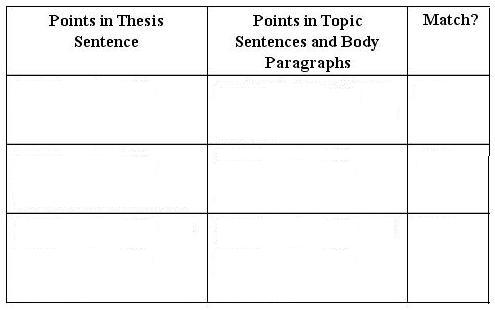
Create a table that has three columns and four rows:


Label the top rows like this:


Now, as you check the points in your thesis against the points in your topic paragraphs (and the development of these points in the topic sentences’ respective body paragraphs), place “YES” in the “Match?” column if the points match or “NO” if they do not match.


Your matching game shows that the first point in your thesis sentence does NOT match the point in your first topic sentence or the way that the point in the topic sentence is developed in its body paragraph and that the second and third points in your thesis sentence DO match their counterparts in the second and third topic sentences and are developed correctly in these topic sentences’ respective body paragraphs. You have uncovered a very important error in your paper.

Fortunately, there is an easy way to correct the error and save your grade!

Simply change the second point in your thesis so that it matches the point that you actually make in your first topic sentence and support and develop in its body paragraph. Instead of turning in your paper with the original thesis sentence, turn in a revision with the corrected thesis sentence, which NOW reads:

Mr. X is an ineffective instructor because he is rude, inconsiderate, and insensitive toward his students; he does not lecture on a level that is appropriate to his freshmen students; and he assigns class work and homework that do not relate to the course objectives.
Notice we had to replace the commas between the items in the series with semicolons because the items in the first of the three phrases now contains commas, which the original phrase lacked: “he is rude, inconsiderate, and insensitive toward his students.”

Sunday, July 17, 2011

Advertisement Analysis Essay 1

Copyright 2011 by Gary L. Pullman

According to Jib Fowles, to sell products and services, advertisers appeal to one or more of fifteen emotions:

1 The need for sex
2. The need for affiliation
3. The need to nurture
4. The need for guidance
5. The need to aggress
6. The need to achieve
7. The need to dominate
8. The need for prominence
9. The need for attention
10. The need for autonomy
11. The need to escape
12. The need to feel safe
13. The need for aesthetic sensations
14. The need to satisfy curiosity
15. Physiological needs: food, drink, sleep, etc.

In addition, I have found, most advertisements also use a visual metaphor, texts which often involve a play on words and suggests the visual metaphor, and, of course, various visual design elements (such as models, props, color, size, shape, and texture). In fact, in an assignment that I give my freshman composition students, I ask them to use the following sentence to structure their advertising analysis essay:

The name of product advertisement in Title of Magazine uses a metaphor to equate the product to an object or experience to which the advertised product is equated and uses such visual design elements as identify specific elements (colors, shapes, props) to sell the product.
To provide a model, I then offer this sample five-paragraph essay, first identifying the thesis sentence and the topic sentences, which I underline in the essay itself:

THESIS: To sell a men's magazine, the Ché advertisement in Commuter World magazine uses a metaphor to equate the product to a “better” dream world and shows a promiscuous young woman approaching a trolley station.

TOPIC SENTENCE 1: The advertisement’s text, “Let’s keep dreaming of a better world,” equates Ché magazine to a place in which beautiful, promiscuous young women are readily available to any man.

TOPIC SENTENCE 2: The female model is shown from behind, so that the viewer is encouraged to see her as an object rather than as a person.

TOPIC SENTENCE 3: The model approaches a trolley station, which symbolizes the connection that she intends to make with the train that will take her to her destination.
I also include a picture of the advertisement. Here’s the result:

INTRODUCTORY PARAGRAPH: Men’s magazines feature articles concerning topic of interest to their subscribers: alcoholic beverages, sporty automobiles, hunting and fishing, politics, scientific and technological breakthroughs, workplace guidance, travel and tourism, and, of course, dating. Some, such as Playboy, also boast of interviews with the rich and famous and of short stories by popular or even renown writers. There are apt to be jokes and cartoons, too, mostly about sexual matters. The mainstay of such magazines, however, isn’t the news, advice, humor, or fiction, but the photographs of beautiful young women wearing little or no clothing. It makes sense, then, that an advertisement for a men’s magazine, whether foreign or domestic, would appeal to such periodicals’ strongest selling point. If humor can be used to make the sales pitch, so much the better, but, when it comes to promoting men’s magazines, nothing sells as well as sex, as marketers for the European men‘s magazine Ché are well aware. To sell a men's magazine, the Ché advertisement in Commuter World magazine uses a metaphor to equate the product to a “better” dream world and shows a promiscuous young woman approaching a trolley station.

BODY PARAGRAPH 1: The Ché advertisement in Commuter World magazine uses a metaphor to equate the product to a “better” dream world. The accompanying text at the bottom of the advertisement, which is printed in smaller font than the message on the model’s skirt, indicates that the image that the advertisement creates--of a nubile young woman who is available to anyone who is interested in calling her--is a fantasy: “Let us keep on dreaming of a better world.” The advertisement has a playful tone, suggesting that the “better world” to which it alludes would be a fun place to be, and the fun would be of a physically intimate variety. Following this fine print, as it were, is the logo that identifies the product that the advertisement is selling, Ché, a “men’s magazine.” The model seems to represent the sort of fantasy girl that the magazine is apt to feature on a routine basis. By purchasing or subscribing to this magazine, customers gain admittance to the “better world” of fun-loving, available dream girls.

BODY PARAGRAPH 2: The female model is shown from behind, so that the viewer is encouraged to see her as an object rather than as a person. Her face is not shown. Therefore, the emphasis of the picture is on her body, rather than her face, on the physical rather than the personal. She is an object, rather than a person. She wears a simple, green top that exposes her midriff, a charm bracelet, and a white mini-skirt. A small, simple, black purse is slung over her right shoulder. She is the largest object in the picture, and she is the closest to the image’s center, her positioning within the picture, like her size, emphasizing her over everything else that is depicted in the advertisement. Next to the figure of the young woman herself, the most outstanding prop in the picture is her skirt. It is short enough to reveal the lower portions of her buttocks, which are bare, suggesting that she either wears a thong or no underwear at all. The exposure of these parts of her anatomy draws the eye, as does the apparent fringe that adorns the bottom of her skirt, some of the tassels of which are missing, revealing the parts of her buttocks that show. There is something else odd about the fringe: the tassels, which are short, rectangular strips, bear printed text that is too small to read. However, on the seat of her skirt, in red cursive lettering, below which is an arrowhead, pointing downward, is the message, “My number.” This message makes it clear to the advertisement’s viewer that the text printed on the tassels identifies her telephone number. Her skirt is itself an advertisement of the sort that includes, along its bottom edge, a series of tags that are printed with a telephone number to which those who are interested in the product or the service that the advertisement promotes may respond. Essentially, the model is saying, to all interested parties, “Call me.” It is based upon a play on words, alluding to the common phrase, “I have your number.”

BODY PARAGRAPH 3: The model approaches a trolley station, which symbolizes the connection that she intends to make with the train that will take her to her destination. The train represents opportunity. The model is approaching the station. If the viewer were present, he might meet her, and, if he were to join her on the trolley, the train might convey him--or, rather, him and the young woman--to a common destination. The silent text of the advertisement seems to be. “Don’t miss the train!” and represents a call to action, or, in the language of the trade, the closing sales pitch. From a Freudian point of view, the train is also a phallic symbol, which suggests, even more clearly, the sexual nature of the destination to which the young woman and her date will travel, if he calls her and arranges to meet her at the station.

CONCLUDING PARAGRAPH: If advertisements are any indicator of such matters, it seems safe to say that men and women are interested in vastly different types of pursuits. Advertisements in women’s magazines indicate that women are interested in spotless kitchens, a healthy, well-fed family, a clean home, fashionable clothing and accessories, travel, interior design, furniture, and business careers. Men’s magazines’ advertisements suggest that their readers’ interests are fewer by far and simpler: food, sex, and cars. An advertisement for Ché men’s magazine, in fact, makes it clear that many men would welcome as “a better world” one in which women are not only readily available sexually but travel to one’s doorstep, in answer to a telephone call. For most men, the advertisement suggests, life just doesn’t get any better than that!

Friday, May 16, 2008

Planning Your Essay

copyright 2008 by Gary L. Pullman


Audrey Hepburn as Eliza Doolittle in My Fair Lady

High school teachers and college instructors complain about students' essays being disorganized, unsupported, and undeveloped. In other words, they complain that students' writing is unfocused, vague, and general. If you use the principles we identified in "Essay Patterns of Development," your essay won't have these problems. However, it is often difficult for students to generate enough details to support and develop their thesis and topic sentences fully and completely. As a result, teachers and instructors conclude that the students' claims (thesis and topic sentences) are unconvincing or unsubstantiated. In this post, we will show how planning your essay can provide the specificity (the specific details) that are needed to make your claims convincing to your readers (in school, usually your teachers, instructors, and, sometimes, fellow students).

Let's assume that, using the "Three-Step Brainstorming Process" or the "Thesis Trident," you have generated this thesis concerning two movies, My Fair Lady and She's All That, that you watched in class:

In both movies, a bet results in the antagonists’ transformation, which, in turn, leads to the protagonists’ transformation.

This thesis, in turn, becomes the basis for developing these three topic sentences:

The main characters bet that they can transform the antagonists.
As a result of the bet, Eliza and Laney are transformed.
The antagonists’ transformations transform the protagonists.
Now, select examples from the movies that illustrate each of these topic sentences:

The main characters bet that they can transform the antagonists.

Professor Higgins bets Colonel Pickering that he (Professor Higgins) can pass Eliza Doolittle off as a “duchess at the embassy ball.”

Professor Higgins teaches Eliza to speak properly.

He uses rote learning (memorization) techniques to teach her to pronounce words
correctly.
He insists that she practices pronunciation drills.
He assigns her appropriate conversation topics.
Professor Higgins teaches Eliza to act like a lady.

He directs his housekeeper to bathe Eliza.
Professor Higgins and Colonel Pickering pick out dresses for Eliza to wear.
Professor Higgins teaches Eliza to behave properly.
He rehearses Eliza at the Ascot racetrack.
Eliza is in mixed company, among high society folk.
Eliza fails the test.
Professor Higgins faces a penalty if he loses the bet.

He would have to pay his own expenses.
He would have to set Eliza up as a flower shop owner.
Zach Siler bets Dean Sampson that he (Zach) can make Laney Boggs their high school’s annual prom queen.
Zach helps Lanie to socialize.
To help her to become more popular, Zach introduces Lanie to his friends.
Zach faces a penalty if he loses the bet: he must appear naked at his high school graduation ceremony.
As a result of the bet, Eliza and Laney are transformed.
Eliza develops self-esteem and self-confidence, and she becomes more assertive.

When Freddie Eynsford-Hill and the prince at the embassy ball are attracted to her, Eliza understands that men can find her attractive, which increases her self-esteem.
When Colonel Pickering treats Eliza courteously, she understands that she is worthy of being treated with respect, which also enhances her self-esteem.
When Eliza passes herself off as a princess at the embassy ball, she gains self-confidence.
When Eliza realizes that she can act independently of Professor Higgins, she becomes more assertive.
Lanie becomes more outgoing and more popular, gaining self-esteem and assertiveness.

Zach accompanies Lanie to the theater and takes her to the beach, where she must
interact with her peers.
Zach introduces Lanie to his friends, who are members of the in-crowd.
Although Lanie does not win the title of prom queen, she is a close runner-up, which suggests that she has gained a good deal of popularity.
Lanie gains enough assertiveness to stand up for her values, even if they make her less popular.

The antagonists’ transformations transform the protagonists.

Professor Higgins comes to think of Eliza as a person.
After Eliza stands up to him, showing him that she is an independent individual deserving of respect, Professor Higgins is attracted to Eliza.He begins to treat her with respect.
He wants to become friends with her because of who she is rather than because of what he may gain from his association with her.

Zach falls in love with Lanie.
After Lanie insists upon living according to her own values, Zach respects her
as a person.
He wants to become friends with her because of who she is rather than because of what he may gain from his association with her.
By planning your essay ahead of time, thinking of the various examples from the movies themselves that you can use to support and develop each of your essay's topic sentences, you have generated a lot of specific material that will make your claims (thesis and topic sentences) convincing to your readers. In fact, the essay has almost written itself. Basically, all you have left to do is to write an introductory paragraph and a concluding paragraph, add transitions, and add any additional examples that come to mind as you write the first draft of your essay. The result might be something like this (the thesis is in bold font; the topic sentences are underlined):


A Lady Is As A Lady Does

by Gary L. Pullman

What is a lady? In part, the answer to this question depends upon the society in which a woman lives, for this term is defined by others--the members of the upper class--who determine what it shall mean. The definition of the term "lady" is likely to change with the times, and it is also likely to differ from one place to another. In nineteenth-century London's high society, being a lady meant something far different than being a lady meant among the in-crowd of a twentieth-century American high school. In both cases, those who had the power to define the social significance of other people's status, or standing, in society defined which women could be considered ladies and which could not be considered to be such. Often, such distinctions are based upon arbitrary, superficial standards. In the movie My Fair Lady, it is mostly how a woman appears and acts that determines whether she shall be considered a lady, whereas, in She's All That, it is largely a matter of whether a girl is popular among her peers that determines whether she shall be considered a lady. The absurdity and superficiality of these social class distinctions is made clear by the idea that a woman can change stations as a result of subterfuge and artifice. In both movies, a bet results in the antagonists’ transformation, which, in turn, leads to the protagonists’ transformation.

The main characters bet that they can transform the antagonists. Professor Higgins bets Colonel Pickering that he (Professor Higgins) can pass Eliza Doolittle off as a “duchess at the embassy ball.” Professor Higgins teaches Eliza to speak properly. He uses rote learning (memorization) techniques to teach her to pronounce words correctly. He insists that she practices pronunciation drills. He assigns her appropriate conversation topics, advising her to speak only about "the weather and everyone's health." Professor Higgins teaches Eliza to act like a lady. He directs his housekeeper to bathe Eliza. Professor Higgins and Colonel Pickering pick out dresses for Eliza to wear. Professor Higgins teaches Eliza to behave properly, teaching her the difference between a handkerchief and her sleeve. He rehearses Eliza at the Ascot racetrack. Eliza is in mixed company, among high society folk.Eliza fails the test. Professor Higgins faces a penalty if he loses the bet. He would have to pay his own expenses.He would have to set Eliza up as a flower shop owner. Zach Siler bets Dean Sampson that he (Zach) can make Laney Boggs their high school’s annual prom queen. Zach helps Lanie to socialize. To help her to become more popular, Zach introduces Lanie to his friends. Zach faces a penalty if he loses the bet: he must appear naked at his high school graduation ceremony.

As a result of the bet, Eliza and Laney are transformed. Eliza develops self-esteem and self-confidence, and she becomes more assertive. When Freddie Eynsford-Hill and the prince at the embassy ball are attracted to her, Eliza understands that men can find her attractive, which increases her self-esteem. When Colonel Pickering treats Eliza courteously, she understands that she is worthy of being treated with respect, which also enhances her self-esteem. When Eliza passes herself off as a princess at the embassy ball, she gains self-confidence. When Eliza realizes that she can act independently of Professor Higgins, she becomes more assertive. Lanie becomes more outgoing and more popular, gaining self-esteem and assertiveness. Zach accompanies Lanie to the theater and takes her to the beach, where she must interact with her peers. Zach introduces Lanie to his friends, who are members of the in-crowd. Although Lanie does not win the title of prom queen, she is a close runner-up, which suggests that she has gained a good deal of popularity. Lanie gains enough assertiveness to stand up for her values, even if they make her less popular.

The antagonists’ transformations transform the protagonists. Professor Higgins comes to think of Eliza as a person. After Eliza stands up to him, showing him that she is an independent individual deserving of respect, Professor Higgins is attracted to Eliza. He begins to treat her with respect. He wants to become friends with her because of who she is rather than because of what he may gain from his association with her. Zach falls in love with Lanie. After Lanie insists upon living according to her own values, Zach respects her as a person. He wants to become friends with her because of who she is rather than because of what he may gain from his association with her.

Both My Fair Lady and She's All That show that the powerful, whether they are the members of society's upper class or the most popular crowd in a high school, determine the social status of others, including women. Whether a woman is to be considered a lady and is to be treated accordingly depends not so much upon who she is herself as it does upon what others--the social elite--think of her. These movies suggest that social class distinctions are often based upon superficial, or even absurd, standards, such as one's appearance, manner of speech, and popularity. Nevertheless, these distinctions have real effects both upon how women are treated by others and upon how they think and feel about themselves. These movies also show the power of love to transform others, for it is when Professor Higgins truly becomes friends with Eliza and when Zach falls in love with Lanie that their feelings for the women they’ve transformed into ladies allow the ladies to transform them into men who care about them as people rather than as creations whose transformations reflect nothing more than their winning of a cruel bet. Love, not appearance, dress, manner, and popularity, these movies suggest, is the basis for real relationships and significant transformation.

Rachel Leigh Cook as Lanie Boggs in She's All That

Tuesday, May 13, 2008

The Thesis Trident

copyright 2008 by Gary L. Pullman

Before writing an essay, give careful planning, both to the thesis (what you want to say--the claim that you are making about your essay's topic) and what you want to say about it (including the evidence you intend to present in support and development of the claim, or thesis). We saw how, in an earlier post, you can profit from brainstorming about your essay's topic in order to generate a thesis for it and details of support and development for the thesis. In this post, we are considering how outlining your topic can be helpful in supporting and developing a thesis.

In "A Three-Step Brainstorming Process," we learned how to use three simple steps to generate a thesis for any type of essay.

In this post, we introduce another simple, sure-fire way of generating a thesis for any type of essay, the Thesis Trident.

Contruct a trident like this:

At the top, write the essay's topic. In this case, the essay (a comparison-contrast essay) that deals with two movies, My Fair Lady and She's All That, so we write "My Fair Lady and She's All That" (without the quotation marks) at the top of the Thesis Trident:


My Fair Lady and She's All That


At the end of each point of the Thesis Trident, write one of the three related points that will make up your thesis' plan of development. Here, we have chosen these three points:
  1. Bet
  2. Antagonists' transformations
  3. Protagonists' transformations
Therefore, we place one of these points at the end of each of the Thesis Trident's three points.
My Fair Lady and She's All That
Now, by reading in a counter-clockwise direction (around to the right, from the top to the bottom right side of the Thesis Trident) and inserting necessary words, such as a verb, any prepositions, conjubctions, articles, and other connecting words, we the Thesis Trident all but generates a thesis sentence for us:
In My Fair Lady and She's All That, bets result in the antafonists' transformations, which, in turn, lead to the protagonists' transformations.
Viola! You've generated a sound, clear, specific, three-point thesis sentence for a comparison-contrast essay concerning the bets between characters and the outcomes of those bets in these two movies. Again, the Thesis Trident can be used to generate a thesis sentence for any kind of essay.

Process Analysis Development Template

copyright 2008 by Gary L. Pullman


Note: We recommend that you read our "Essay Patterns of Development" post before you read this post.

Process Analysis: Explain the steps by which something occurs or by which a person accomplishes a particular process (a series of steps that results in a specific, predetermined outcome).

Note: If there are more than three steps, group them into three phases or stages. (In actuality, a process may involve many steps, but for the purpose of this essay, present only three steps, phases, or stages.)

Topic: Prepare to deliver a short speech in a public setting


Use this blank template to generate a thesis for your own process analysis essay:

THESIS:

Persuasion Development Template

copyright 2008 by Gary L. Pullman

Note: We recommend that you read our "Essay Patterns of Development" post before you read this post.

Persuasion: Use appeals to emotion and reasons to convince your audience to accept your point of view or to perform an action that you recommend.

Note: Argumentation is similar to persuasion, except that persuasion’s primary technique is to appeal to the emotions to convince the reader to adopt a point of view or to take a particular action, supporting emotional appeals with optional, appropriate, but supplemental, reasons for doing so.

Topic: Persevere in the pursuit of your college degree

Use this blank template to generate a thesis for your own persuasive essay:

THESIS:

Narration Development Template

copyright 2008 by Gary L. Pullman

Note: We recommend that you read our "Essay Patterns of Development" post before you read this post.

Narration: Tell a story that illustrates a point, such as a lesson learned about an important aspect of life; make sure the beginning of the narrative sets up a conflict, the middle of the narrative develops a conflict, and the end of the narrative resolves a conflict that is related to the theme (lesson).

Topic: Loss of a family heirloom


Use this blank template to generate a thesis for your own narrative essay:


THESIS:


Monday, May 12, 2008

Exemplification Development Template

copyright 2008 by Gary L. Pullman

Note: We recommend that you read our "Essay Patterns of Development" post before you read this post.

Exemplification (Illustration): Use examples to illustrate the points in your thesis sentence’s plan of development.

Topic: Monsters as metaphors


THESIS: Fictional monsters represent various real spiritual, psychological, and social, threats, including greed, drunken behavior, and the social destructiveness of feuds.
Use this blank template to generate a thesis for your own exemplification essay:


THESIS:

Division Development Template

copyright 2008 by Gary L. Pullman

Note: We recommend that you read our "Essay Patterns of Development" post before you read this post.

Division: Separate items on the basis of their different characteristics or qualities.

Note: Division is often used with classification in the development of a classification-division essay.

Topic: Tragic main characters


THESIS: Oedipus Rex, Hamlet, and Julius Caesar are warned of danger by various supernatural means, are murdered by dissimilar killers, and treat their wives or girlfriends in different ways.
Use this blank template to generate a thesis for your own division essay:

THESIS:

Description Development Template

copyright 2008 by Gary L. Pullman

Note: We recommend that you read our "Essay Patterns of Development" post before you read this post.

Description: Depict a person, a place, or a thing through words, phrases, and sentences that appeal to one or more of the five physical senses.

Note: To describe a person, place, or thing, use adjectives (sparingly), vivid action verbs, figures of speech (metaphors, similes, personifications, images), and juxtapositions that highlight the appearance, condition, and quality of the person, place, or thing being described.


THESIS: The colors and furnishings of a church sanctuary, like the songs and music and the scents that are characteristic of it, symbolize the presence of God.
Use this blank template to generate a thesis for your own descriptive essay:

THESIS:

Contrast Development Template

copyright 2008 by Gary L. Pullman

Note: We recommend that you read our "Essay Patterns of Development" post before you read this post.

Contrast: Identify the points of dissimilarity (difference) between two persons, places, or things, and show how (and possibly why) they are different in these ways.

Note: Contrasts are often used with comparisons in the development of a comparison-contrast essay.

Topic: Vampires and zombies


THESIS: The legends concerning vampires and zombies differ, as do the religions with which they associated and the difficulty with which they are destroyed.

Use this blank template to generate a thesis for your own contrast essay:


THESIS:

Sunday, May 11, 2008

Comparison Development Template

copyright 2008 by Gary L. Pullman

Note: We recommend that you read our "Essay Patterns of Development" post before you read this post.

Comparison: Identify the points of comparison between two persons, places, or things, and show how (and possibly why) they are alike in these ways.

Note: Comparisons are often used with contrasts in the development of a comparison-contrast essay.

Topic: Vampires and zombies


THESIS: Vampires and zombies are revenants who feed on people and are driven by simple motives.Use this blank template to generate a thesis for your own comparison essay.

Use this blank template to generate a thesis for your own comparison essay:

THESIS:


Classification Development Template

copyright 2008 by Gary L. Pullman

Note: We recommend that you read our "Essay Patterns of Development" post before you read this post.

Classification: Group items on the basis of shared characteristics or qualities.

Note: Classification is often used with division in the development of a classification-division essay.

Topic: Tragic main characters


THESIS: Oedipus Rex, Hamlet, and Julius Caesar were rulers who made serious errors in judgment that resulted in their own deaths and the deaths of others.
Use this blank template to generate a thesis for your own classification essay:


THESIS
:

Analysis Development Template

copyright 2008 by Gary L. Pullman

Note: We recommend that you read our "Essay Patterns of Development" post before you read this post.

Analysis: Identify the parts that make up a whole and explain how each functions individually, how each is related to the other, and how they work together to serve a greater, common purpose (the function of the whole).

Topic: Story

Function of the Whole: A story recounts the actions of a character who struggles to attain a goal.


THESIS: The beginning of a story, which is known as the exposition, provides background information and sets the rest of story in motion; the middle, called the turning point, changes the protagonist’s fortune for better or worse; and the end, known as the resolution, determines the outcome of the conflict (the protagonist attains or fails to attain his or her goal).
Use this blank template to create your own thesis for an analytical essay:


THESIS:

Essay Patterns of Development

copyright 2008 by Gary L. Pullman


A generic table (Generic Table for Generating a Thesis Sentence) helps students to understand that the thesis sentence for a typical high school or freshman college essay contains a plan of development that breaks the essay’s topic into three related points; these points are the bases, in turn, of the topic sentences for the essay’s three body paragraphs.

However, more specific tables help students to customize this concept, adapting it to particular patterns of development.

Essays are composed according to a number of patterns of development:
  • Analysis
  • Argumentation
  • Causal analysis (cause-effect)
  • Classification (usually used with division)
  • Comparison (usually used with contrast)
  • Contrast (usually used with comparison)
  • Definition
  • Description
  • Division (usually used with classification)
  • Evaluation
  • Exemplification, or illustration
  • Narration
  • Persuasion
  • Process analysis (“how to”)
Note: Rhetoric and composition courses usually break these patterns of development into the following groups:
  • Definition
  • Description
  • Exposition
  • Causal analysis (cause-effect)
  • Classification-division
  • Comparison-contrast
  • Evaluation
  • Process analysis (“how to”)
  • Narration
  • Persuasion and argumentation
Charts, or tables, each consisting of one or more rows and several columns, provide a visual means of organizing material for essays that employ each of these patterns of development.

Each of these essay templates can be used to generate a thesis sentence that includes a plan of development containing three related points. The beginning of the thesis sentence will be the template’s topic (sometimes, slightly reworded), identified in the template’s left column, and the plan of development will be the three points listed in the template’s other three columns. For example, from the following template, this thesis sentence may be derived:


THESIS: Vampires and zombies are revenants who feed on human beings and are driven by simple motives.
Likewise, from the following table, this thesis may be developed:

THESIS: The legends concerning vampires and zombies differ, as do the religions with which they associated and the difficulty with which they are destroyed.

These tables are effective templates, but they have several limitations that the instructor must keep in mind. In some cases, their use implies an understanding of certain terms (e. g., metaphor, simile, personification, image, juxtaposition) that students may not have. In such cases, the instructor will need to define and exemplify the meanings of such terms before the students use the template. In other instances, as when a cause-effect, a comparison-contrast, or a classification-division essay (rather than simply a cause or an effect essay, a comparison or a contrast essay, or a classification or a division essay) is required, one template must be used with another, and some revision as to the employment of the templates may be in order.

For example, suppose a student were required to write a comparison-contrast essay. First, he or she should use the Comparison Essay template to identify the points of similarity between the two persons, places, or things that are to be compared. Then, he or she should use the Contrast Essay template to identify the points of difference between the two persons, places, or things that are to be contrasted. Then, the comparisons and contrasts should be linked in a single thesis sentence. Here is an example:

THESIS: Although vampires and zombies are both revenants who feed on human beings and are driven by simple motives, the legends concerning these monsters differ, as do the religions with which they associated and the difficulty with which they are destroyed.

Another note of caution is in order concerning the use of these tables. Most essays require a thesis that states not only facts but an interpretation of the facts (an opinion concerning them). These templates do not necessarily yield such a thesis. However, an opinion can be added, as is done in the case of the following thesis:

THESIS: Vampires are more complex villains than zombies because, although both monsters are revenants who feed on human beings and are driven by simple motives, the legends concerning vampires are more elaborate than those concerning zombies, as is the religion with which vampires are associated and the difficulty with which vampires are destroyed.

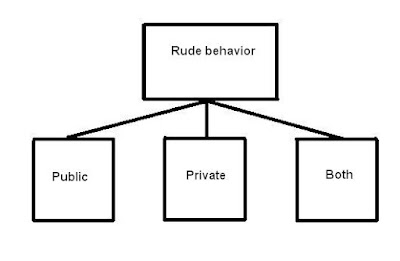
Generic Table for Generating a Thesis Sentence

This generic table helps students to understand that the thesis sentence for a typical high school or freshman college essay contains a plan of development that breaks the essay’s topic into three related points; these points are the bases, in turn, of the topic sentences for the essay’s three body paragraphs.

Once the student has understood this procedure and has practiced it several times using the generic table, he or she should be introduced, as the writing situation warrants each introduction, to the more specific tables that will help him or her to develop material (and theses) that relate to the specific pattern or patterns of development that are best suited to the writing assignment or the writer‘s purpose, whether this assignment or purpose is analysis, argumentation, causal analysis (cause-effect), classification (usually used with division), comparison (usually used with contrast), contrast (usually used with comparison), definition, description, division (usually used with classification), exemplification (illustration), persuasion, or process analysis (“how to”).

To use the generic table, replace “Essay’s Topic” (top rectangle) with the actual topic of the essay that is being written. Then, divide the topic into three related points, listing each point in its own square, in the order in which they will be presented in the essay. By reading down and to the right, in a counterclockwise direction, and adding an appropriate verb and linking words, as necessary, the student can easily develop a thesis sentence that includes a plan of development that contains three related points.

Here is an example:


By adding the verb “can occur,” the preposition “in,” the conjunction “or,” and the phrase “public and private areas of one’s life,” the student will have constructed a thesis sentence that includes a plan of development that contains three related points:

THESIS: Rude behavior can occur in public, in private, or in both public and private areas of one’s life.

Refer to the specific templates that appear in subsequent posts apply this generic technique to particular essay patterns of development written for the student.

Note: Each specific template (table) includes a completed table as a sample and a blank table that can be reproduced for the student’s use.

Essay Checklist

copyright 2008 by Gary L. Pullman

Use this checklist to make sure that you have written the most effective essay you can write. If you are able to answer "YES" (honestly) to each statement, you have done the best that you can do. Any statement t which you must answer "NO" shows you where you need to spend more time editing and revising your essay. Therefore, a "NO" response isn't bad. It's good, because it is helping you to see where you can improve your essay and, therefore, your grade.
  • In the upper left corner of my essay's first page, on line one, my name appears; on line two, my instructor's name appears; on line three, the course name appears; and on line four, the assignment's due date appears.
  • In the upper right corner of each page, my last name and the appropriate page number appears in a header.
  • My essay is typewritten in 12-point Times New Roman font.
  • My essay is left justified.
  • My essay is double spaced throughout (within and between paragraphs).
  • I have maintained one-inch margins at the top, bottom, and both sides of my essay.
  • My essay's title is centered at the top of the first page.
  • My essay's title focuses on the essay's topic.
  • My essay's title is interesting and captures the reader's attention.
  • My introductory paragraph uses an historical review, an anecdote, a surprising statement, a quotation from a famous person to capture my reader’s attention and make him or her want to read more of my essay.
  • My introductory paragraph does NOT apologize for my being a beginning writer, nor does it apologize for my not being an expert about my topic.
  • My introductory paragraph does NOT directly state my purpose, by writing something like “In this paper, I will. . . .” or “The purpose of this essay is to. . . .”
  • My essay does NOT start with a dictionary or an encyclopedia definition.
  • My introductory paragraph ends with my thesis sentence.
  • My thesis is NOT a statement of fact.
  • My thesis states an opinion that is open to discussion.
  • My thesis deals with a significant matter.
  • My thesis is specific, not general, and clear, not vague.
  • My thesis is made up of three related points.
  • Each body paragraph in my essay starts with a topic sentence.
  • The topic sentences refer to the points in my thesis, in the same order in which these points were made in the thesis.
  • I have used an adequate number of specific examples, comparisons, contrasts, quotations, statistics, explanations, and process analyses, as appropriate, to support and develop (provide evidence for) my topic sentences.
  • I have used appropriate transitions to show the nature of the relationships (cause-and-effect, chronological, comparison, contrast, exception to the rule, example, explanation, etc.) among my ideas.
  • My concluding paragraph restates my thesis (states it again, but in different words than I used to state it in the introductory paragraph).
  • My concluding paragraph issues a call to action, if appropriate, or provides another, effective closure for my essay.
  • My essay contains no misspellings.
  • My essay contains no usage errors (“to” or “two” instead of “too,” for example.)
  • My essay contains no punctuation errors (For example, I have made sure that commas and periods appear inside closing quotation marks but that semi-colons and colons appear outside closing quotation marks.)
  • My essay contains no fragments.
  • My essay contains no comma splices.
  • My essay contains no run-on sentences.
  • My essay contains no fused sentences.
  • My essay reflects the best writing of which I am capable.
Note: If your essay includes references to external sources, such as articles in newspapers, magazines, or journals; books; Internet articles; interviews; or other materials, you need to cite and document each and every such item. Refer to the Checklist for Research Papers post. For a sample essay that follows these guidelines (except for the indenting of paragraphs and double spacing, which cannot be replicated in this blog), refer to the "Sample Five-Paragraph Essay" post.

The Five-Paragraph Essay

copyright 2008 by Gary L. Pullman

Many high schools and colleges teach students to write a five-paragraph essay in which:
  1. an introductory paragraph (a) captures the reader's interest, (b) introduces the essay's topic, and (c) ends with a thesis sentence that contains a three-point plan of development;
  2. body paragraph 1 (a) starts with a topic sentence based upon the first point in the thesis and (b) uses specific details to support and develop the topic sentence;
  3. body paragraph 2 (a) starts with a topic sentence based upon the second point in the thesis and (b) uses specific details to support and develop the topic sentence;
  4. body paragraph 3 (a) starts with a topic sentence based upon the third point in the thesis and (b) uses specific details to support and develop the topic sentence;
  5. and ends with a concluding paragraph that (a) restates the thesis sentence in words other than those in which the thesis was stated originally (in the introductory paragraph) and (b) provides an appropriate closure to the essay.

Essays Made Easy uses this three-point thesis, five-paragraph essay format, because it helps to organize the writer's thoughts and provides a clear-cut, effective way of supporting and developing the writer's ideas.

In our next post, we will consider a sample essay that follows this format.