Fascinating lists!

Showing posts with label essay. Show all posts

Tuesday, April 16, 2019

Writing Effective Sentences

Copyright 2019 by Gary L. Pullman


What we have here is a failure to communicate.

To write an effective sentence—a sentence that communicates exactly what you mean—you should practice the follow these principles:

  • Use active voice. (Active voice results from using an active subject and an action verb. Often, the verb is transitive: in other words, it has a direct object.)
  • Use the third person. (All nouns, all indefinite pronouns, and all third-person personal pronouns are in the third person.)
  • Be concise. (Use only the words that are necessary to communicate your precise meaning.)
  • Write with purpose and deliberation, with a specific intention, or aim.
  • Start with a kernel sentence. (A kernel sentence is the shortest possible sentence that you can construct about a topic. Often, a kernel sentence consists of only an active subject and an action verb.)
  • After writing a kernel sentence about your topic, consider what information you need to add to communicate the exact meaning you have in mind. Also consider what additional information, if any, your reader is likely to need to know about the topic as you are writing about it in this particular sentence.) According to philosopher and rhetorician Kenneth Burke, all communication addresses only one or more of these questions: Who? What? When? Where? How? Why? How many or how much? Knowing this about communication can help you to decide what information is necessary to include in any sentence concerning any topic.

Let's practice this approach.

Suppose you are writing about the topic of sharks' attacks.

Start your sentence with these words. “Sharks” is your subject; “attack” is your action verb:

Sharks attack.

Ask yourself, WHAT about shark attacks? (What point do you intend to communicate about a shark attack?)

Sharks attack rarely.

What else do you intend to say about shark attacks?

Sharks attack rarely, and these attacks are seldom fatal.

What is your purpose in communicating these facts? What do you intend to communicate? Perhaps you intend to correct a misconception, such as:

Media reports suggest that sharks attack people frequently.

If this is the case, relate your goal (correcting a misconception about shark attacks) to the sentence you have already written (about the rarity and relative non-lethal number of shark attacks):

Media reports suggest that sharks attack people frequently, but sharks attack rarely, and these attacks are seldom fatal.

To emphasize your point, you can add a phrase such as “in reality”:

Media reports suggest that sharks attack people frequently, but, in reality, sharks attack rarely, and these attacks are seldom fatal.

Let's review what intentions motivated you to construct each new, expanded version of this kernel sentence.

You started with a kernel sentence about a specific topic: “Sharks attack.”

You identified the first point you wanted to communicate about the topic of your sentence: “rarely.”

You decided to add a pertinent fact to the sentence: “and these attacks are seldom fatal.”

You identified your purpose in writing these facts, which was to correct a misconception: “Media reports suggest that sharks attack people frequently.”

You related your purpose to the facts that you had already communicated: “Media reports suggest that sharks attack people frequently, but sharks attack rarely, and these attacks are seldom fatal.”

Finally, you used a phrase to emphasize your point: “in reality.”

As a result of this process, using your intent to determine the content of your sentence, you went from the kernel sentence “Sharks attack” to its final, expanded, complete version: “Media reports suggest that sharks attack people frequently, but, in reality, sharks attack rarely, and these attacks are seldom fatal.”

This approach can work for any sentence concerning any topic.


Thursday, February 16, 2012

A Lesson Learned

Tom Smith
Professor Gary Pullman
English 98
29 September 2011

A Lesson Learned

It is difficult to see oneself as others do. Men and women tend to rationalize their behavior, providing excuses as to why they did or did not perform some action. They often give themselves the benefit of the doubt when they suspect that they may have acted in their own, rather than in another person’s, best interests. They sometimes believe that they act according to motives other than the true ones which inspire their behavior. Such individuals are sometimes dishonest, about both their intentions and their conduct, but, other times, they may simply be mistaken--no one knows him- or herself completely; everyone is capable, at times, of surprising him- or herself. Likewise, people may lack the knowledge or the experience that they need to make objective, realistic, and accurate evaluations of their actions or those of the others with whom they interact. However, some people are simply more selfish than others and do whatever they please, whenever they like. A few are unaware that their actions do not match their inclinations. Occasionally, someone acts as he or she does simply because he or she has no reason or, more commonly, no incentive, to change his or her behavior, even though it may be offensive or annoying to another person. Tom Smith is such an individual. He changed only when his obnoxious behavior became as painful to him as it was to his someone about whom he cared. Once, Tom was stubborn, but after he lost a girlfriend because of his inflexible behavior, he became more open-minded.

Tom always insisted upon having his own way. When his girlfriend, Brenda Lewis, suggested that they drive up the Coastal Highway, from San Diego, so that they could enjoy the ocean scenery, as they passed through the beach cities on their way to Los Angeles, Tom wouldn’t hear of it. He said that he was the driver, not her, and that, as the driver, he would decide which route they drove. They’d made the same trip many times, and he always drove the same route, he told her, for a reason: going by Interstate 5 was quicker than traveling by the Coastal Highway, because the interstate bypassed the very beach cities that Brenda found quaint and charming. Although it was an inland highway that did not offer a view of the ocean, it was more direct and provided only limited access to traffic. What was important, he maintained, was not the view of the terrain through which they traveled but getting to their destination by the most direct and quickest route. Tom also insisted upon doing what he wanted to do. He decided where he and Brenda would eat, what movies they would see, whether and where they would go dancing, and how many friends--and which ones--to invite to the occasional parties he wanted to have. He might appear to listen to her suggestions, but, when the time came to plan their outings or gatherings, he always saw to it that they did things his way. Tom was obstinate about his opinions as well. Others had a right to their views, he admitted, but so did he, and he refused to change his mind about the issues of the day. Whether the topic was relatively unimportant, such as which football team was likeliest to win the Super Bowl or whether to have peanuts, popcorn, pretzels, or all three snack items during the Super Bowl party he hosted every year, or the issue was more significant, such as whether a political candidate’s views were racist, sexist, or unbiased or a job possibility offered benefits and other incentives beyond the wage or salary it paid to make it worth his--or Brenda’s--while, he always maintained that his judgments were sound and need not be changed.

Finally, tired of Tom’s stubbornness, Brenda broke up with him. She had told him on many previous occasions how annoying she found his obstinacy concerning all matters great and small. She had tried to get him to be more open to her suggestions. She had proposed that they compromise. They could travel part of the way from San Diego to Los Angeles on the Coastal Highway and the rest of the way on Interstate 5. He had refused. She had suggested that they each make a list of places that they enjoyed frequenting and of friends whom they liked to invite to their parties, alternating between destinations and each inviting those friends on their respective lists to attend their parties. Again, he had declined. She had invited him to attend lectures on the political topics that various candidates held, so that he could hear both sides of issues and make up his mind as to where he stood on the basis of more complete information. He had rejected her offers. She had suggested that he should decide which jobs he wanted to seek and let her find the ones that appealed to her, but, once more, Tom had demurred. When it became obvious to Brenda that Tom would never change his stubborn ways, she had broken off their relationship.

Although he was a stubborn man, Tom cared for Brenda, and her ending of their relationship affected him enough for him to become more flexible. He does not assume that he knows what is best for everyone else, and he is more willing to listen and to compromise. He has adopted Brenda’s suggestions, and he works hard at being more open-minded, more flexible, and more tolerant of other people and their views. Others find that it is easier for them to get along with him, and, although Tom is not exactly what one might call easygoing, he is nevertheless more cooperative, accommodating, and forbearing. He considers other people’s interests, desires, and needs, and he no longer thinks that everything must go his way or that everyone should think and feel as he does. He has demonstrated considerable growth since Brenda broke up with him.

Tom’s newfound flexibility may have come too late to save his relationship with Brenda, but their separation, although painful, has helped him to understand that obduracy is a severe handicap to human affairs, whether one’s dealings with others are intimate and personal or formal and impersonal. As a result, he has become more adaptable in his dealings with others, and his behavior is no longer annoying. Brenda did him a favor by breaking up with Tom, because he had to confront an unpleasant truth about himself. As a result, he discovered how truly stubborn he had been, and his conduct toward others has become much more open and engaging. Brenda has noticed the change in his behavior, and there is a good chance, she has confided in her best friend, Sally Johnson, of her dating the new-and-improved, much-less-stubborn Tom. Good results can come from needed changes in one’s behavior.

Friday, November 18, 2011

“Luann”: A Situation-Based, Character-Driven Comic Strip

Copyright 2011 by Gary L. Pullman

“Luann,” by Greg Evans, features the teenage exploits of Luann DeGroot; her parents, Frank and Nancy; her brother Brad; Brad’s girlfriend Toni Daytona; Brad’s buddy T. J.; and Luann’s friends and high school classmates, including her best friend Bernice Halper; her romantic rival Tiffany Farrell; and her nerdy admirer Gunther Berger. Occasionally, other characters appear in the strip, including Aaron Hill, the boy upon whom Luann has an unrequited crush; Toni’s abusive ex-boyfriend Dirk; and Bernice’s handicapped, wheelchair-bound ex-boyfriend Zane. The comic strip is aimed at teenage and young adult readers, although its situations and humor appeal to a general audience. Much of the conflict is situation-based and, as the Internet website Toonopedia’s article on the comic strip points out, the strip typically concerns “the ordinary hassles of teenage life,” such as Luann’s or Brad’s interaction with their family and friends, although some sequences include serious or “touchy” issues such as menstruation, “drug abuse,” “drunk driving,” and “cancer” (“Luann”). With the exception of October 25, the theme for the sequence of the comic strip that appeared from October 25 through October 31, 2009, focuses on Halloween and shows the characters’ personalities as they are revealed by their reactions to problems and conflicts that arise from ordinary, everyday situations.


October 25, 2009

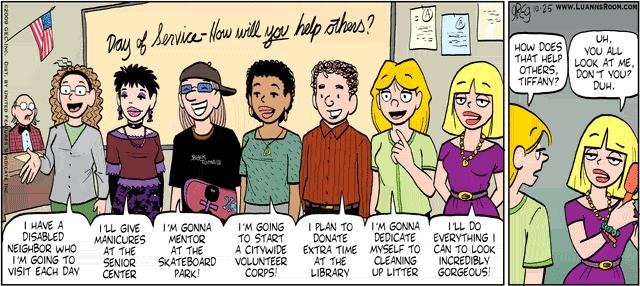
Halloween is a quintessential children’s holiday, and, since “Luann” appeals primarily to teenagers and young adults, its creator focuses most of an entire week’s worth of his comic strip on this festive occasion. The exception is the Sunday, October 25, 2009, edition. All of Evans’ Sunday strips are stand-alone works. They are not part of the daily sequence. Therefore, they must make sense by themselves. The strip for Sunday, October 25, 2009, shows Luann and her friends standing shoulder to shoulder at the front of their classroom. Behind them, the theme of the day’s lesson is written on the chalkboard: “Day of Service--How will you help others?” As their teacher, Mr. Fogarty, looks on, the students tell their peers what each of them intends to do during the Day of Service. Luann is the next to the last in line; Tiffany stands to her left. Each of the students except Tiffany plans to perform a more-or-less significant act of kindness and assistance. Bernice announces that she intends to “visit” a “disabled neighbor.” Crystal plans to “give manicures at the senior center.” Knute will “mentor at the skateboard park.” Delta hopes to “start a citywide volunteer corps.” Gunther intends to “donate extra time at the library.” Luann is going to “clean up litter.” Since all the other students have a relatively important and meaningful task in mind for the Day of Service, the reader anticipates that Tiffany, the last in line, will also have a noble and helpful task in mind. However, her announcement surprises both Luann and the reader. When Tiffany declares that she will do all that she “can to look incredibly gorgeous,” Luann turns to her, in the next panel, and asks, “How does that help others, Tiffany?” Although her explanation (“Uh. You all have to look at me, right? Duh.”) is obviously ludicrous, it reflects her shallow and narcissistic character, and, juxtaposed to her peers’ more important plans to help others, is amusing.


Octiber 26, 2009

The rest of the week focuses upon Halloween. In the October 26, 2009, strip, Frank and Nancy, seated across from one another in their living room, discuss what to hand out to visiting trick or treaters. Nancy confides to her husband, “I didn’t buy Halloween candy. I hate it that kids gorge on sweets, but I don’t know what to give. Carrots? Toys? Dimes?” Her practical husband suggests “garage stuff.” His response seems to surprise Nancy. “What?” she asks him. “We have junk in the garage we plan to sell,” Frank tells her. “Give it to the kids. Win-win.” Unimpressed, Nancy illustrates the absurdity of Frank’s suggestion. Pretending to give the garage items to visiting trick or treaters, she says, as if she were speaking to them, “A bent golf club for you, an ugly tie for you, a half roll of wallpaper for you, a broken lamp for you.” Her humorous protest prompts Frank to response, “See? It’s even kinda scary.” This strip uses a problem--children’s stuffing themselves with “sweets”--to set up a humorous attempt by the characters to find a solution. Nancy’s suggestions for alternative treats (“carrots. . . toys. . . dimes”) are serious, but Frank’s (“junk in the garage”) is both playfully self-serving and humorous. The strip combines a serious health issue with an everyday situation (cleaning out the family’s garage) and a holiday (Halloween) to appeal to a wide audience, which includes both children, adults, parents, and homeowners.


October 27, 2009

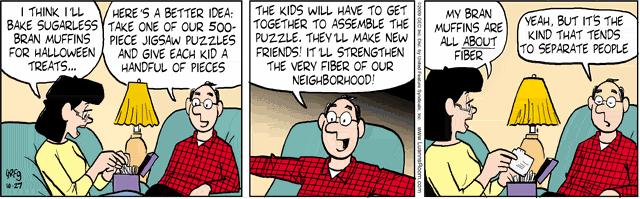
The October 27, 2009, edition of the comic strip continues the situation that the previous day’s installment established: what to give visiting trick or treaters on Halloween. Again, Frank and Nancy are seated opposite one another in their living room. Nancy opens the conversation between them: “I think I’ll bake sugarless bran muffins for Halloween treats.” Frank offers an interesting alternative. At first, it sounds ridiculous, even a bit cruel: “Here’s a better idea. Take one of our 500-piece jigsaw puzzles and give each kid a handful of pieces.” However, in the next panel, he explains his reasoning, and the idea doesn’t seem as absurd: “The kids will have to get together to assemble the puzzle. They’ll make new friends! It’ll strengthen the very fiber of our neighborhood!” Nancy’s response is based upon a play on the word “fiber” that Frank has used. “My bran muffins are all about fiber,” she observes. “Yeah,” Frank replies, “but it’s the kind that tends to separate people.” His response suggests that the fiber in the muffins will facilitate the children’s need to use the bathroom, since fiber has a laxative effect on people, and their doing so will cause them to “separate” rather than to “assemble.” This strip shows that both Nancy and Frank care about the welfare of children. Nancy has their health in mind, whereas Frank is concerned with their social wellbeing. Their proposed solutions to the problem of what treats to hand out to children on Halloween also show them to be creative. The conflict between them is gentle and rational, rather than harsh and emotional, showing that they are mature and logical adults. Like many of Evans’ other strips, this one, based upon a specific situation, reveals the traits of his characters’ personalities.


October 28, 2009

The October 28, 2009, edition of the comic strip continues the same situation, as Frank, discovering a kitchen “drawer full of rubber bands from the newspaper” to which they subscribe, suggests to Nancy, as she pours a cup of coffee, “Let’s give these out to the trick or treaters.” She asks a logical question in response, wondering what the recipients “are supposed to do with a rubber band.” In the next panel, Frank explains, “Honey, they’re kids. They’ll think of things.” Nancy agrees, but her rejoinder suggests that the “things” of which the children are apt to think to do with the rubber bands may be undesirable and, potentially, hazardous: “Yeah. Like zing you upside the head as you close the door.” Frank’s suggestion is based upon his understanding that children are imaginative, but Nancy’s comeback addresses another facet of adolescent behavior. Children, she suggests, are also unruly, and their rowdiness could cause unpleasant or dangerous results. It is evident that both characters, as the parents of Luann and Brad, understand children well. The strip also seems to imply that, in caring for children, two heads are better than one, because both Frank and Nancy contribute to an awareness of the nature of children which is truer and more developed than either of their perceptions would be by itself. Children are imaginative, as Frank points out, but they are also immature and disorderly at times, as Nancy indicates.


October 29, 2009

The October 29, 2009, edition of “Luann” is atypical in that it is not humorous in itself. Rather, it sets up the strip that is to appear the next day and, as the inclusion of a web address in the lower right corner of its single panel indicates, it is more of a public service effort than it is an attempt to tell a joke or to express humor. This time, the action, such as it is, occurs in Luann’s bedroom, as her dog, Puddles, sleeps on her bed and her best friend, Bernice, reading a magazine or a book, lounges on the floor, her back against the side of the mattress, while Luann contemplates a large collection of books in her bookcase. Bernice reads to Luann some facts that have captured her attention: “Wow. In America, kids collect almost 3 billion pieces of candy on Halloween.” She finds this information disturbing because of the hazards to children’s health that it represents: “That’s a lot of hyper, obese, bad-teeth kids.” Luann, contemplating her bookcase, says, “Look at all these old children’s books of mine. Wonder what I could do with them?” A teenager, she has outgrown the “children’s books.” What were once welcome diversions are now undesirable clutter to her. However, possibly because they have sentimental value to her, she doesn’t appear to want to simply discard them, for she wonders what she “could do with them.” The strip for the next day will provide the solution to her problem.


October 30, 2009

In the October 30, 2009 strip, Frank and Nancy are still trying to resolve their problem as to what to give trick or treaters in lieu of candy. This time, they are seated at the dining room table. Nancy names “apples” and “stickers” and other possibilities. Frank, once again, suggests an absurd alternative: “paper clips.” As her parents struggle with the issue, Nancy listing their ideas on a sheet of paper, Luann approaches them, carrying a tall stack of books. “How ‘bout givin’ my old children’s books?” she suggests. In the next panel, the parents are alone again, Luann having left the stack of books on the table. Her mother and father stare at the books, speechless. In the last panel, Nancy tosses her crumpled list as Frank offers the strip’s punch line: “It’s scary when she’s more clever than we are, isn’t it?” Although this strip, considered in isolation from the previous editions in the sequence, is not all that amusing in itself, its humor becomes funnier because it builds upon the continuing situation that previous days’ editions of the strip have developed, this one becoming, as it were, not only amusing in itself but the punch line for the whole series of related strips to date. Because Frank and Nancy have considered a series of possible alternatives to the giving of candy to visiting children as Halloween treats without success, Luann’s casual resolution of their long-running dilemma is also amusing, since she is a teenager, while they are adults. Usually, the parents solve problems, but, in this strip, the roles of parents and child are reversed, which helps to fuel the amusement.


October 31, 2009

The October 31, 2009, edition of the comic strip represents the culmination of the Halloween-based series as children visit the DeGroot household to trick or treat. Luann hands out the books. “Just for you,” she says to a girl in a witch’s costume, naming the title of the book she is giving her, “If I Ran the Zoo.” Her announcement of the book’s title brings her father running, as he cries out, in horror at the thought of the loss of the book, “That book is inscribed by Ted Geisel inside!” His announcement shocks Luann, who stares wide-eyed and speechless. “Ted Geisel” is the actual name of the author who has written a popular series of children’s books under the pen name “Dr. Seuss.” The fact that he has “inscribed” the book that Luann is giving away suggests that the volume may be worth a fair amount of money. As such, it is not something that is appropriate to be given away to a child, which explains Frank’s horror and the speed with which he intervenes, as well as Luann’s own shock. Luann’s diplomatic way of resolving this crisis is to offer the child two books for the one that she originally gives her, and the girl gladly accepts, so that, at the end, everyone--the girl, Luann, and Frank--is content with the outcome. Luann’s actions show her to be sensitive, kind, and tactful. She may be a teenager, but she is maturing well emotionally and morally, her behavior suggests. She is also witty, because her dialogue, constituting, as it does, a rhymed couplet, in her offering of two books for the one she originally gives the girl, resembles the rhyming couplets in which Dr. Seuss’ books are written.

Just as she earlier solved her parents’ dilemma concerning what to give trick or treaters instead of candy, Luann now resolves the crisis of reclaiming the book she originally gives a child in a diplomatic, and even witty, manner. Although her parents are obviously mature adults--Frank provides for the financial necessities of a family of four, just as Nancy keeps house for them, and both parents show an understanding of and a concern for both their own children and children in general--both Nancy and Frank can also act childishly on occasion, as is indicated by Frank’s panic at the possibility of losing a book signed by a famous author and his grabbing it out of Luann’s hands the moment she retrieves it from the trick or treater and Nancy’s earlier insistence that her bran muffins are superior to Frank’s suggestion for a Halloween treat because her muffins would be “all about fiber.” The comedy of “Luann” springs from Evans’ display of his characters’ personalities through their responses to the problems and conflicts which arise from specific situations related to everyday life. Such humor appeals to children, teenagers, parents, and other adults alike.

Works Cited

Evans, Greg. “Luann.” Comic Strip. The Las Vegas Review-Journal.
25 Oct. 2009-31 Oct. 2009: C8. Print.

Markstein, Don. (2009). Luann. Don Markstein’s Toonopedia. Retrieved November 4, 2009, from
http://www.toonopedia.com/luann.htm .
  

G. K. Chesterton’s “A Piece of Chalk”: Paragraph By Paragraph

Copyright 2011 by Gary L. Pullman

In the first paragraph of his essay, “A Piece of Chalk,” G. K. Chesterton creates a foil, so to speak, in the person of an elderly homeowner whom he describes as “square and sensible.” (A foil is a character whose personality consists of traits that are opposite to those of the main character and, therefore, highlight the protagonist’s own personality traits. In other words, Chesterton’s first-person narrator will believe differently, think differently, feel differently, and act differently than the homeowner.) The adjectives “square” and “sensible” suggest that the homeowner is conventional, practical, and, perhaps, unimaginative; since she is a foil to the essay’s narrator, the narrator himself will be unconventional, impractical (or, rather, romantic and idealistic), and imaginative. The rest of the opening paragraph shows readers that they are correct in having made these assumptions about both the foil and her opponent, the narrator. When the latter asks the former for “brown paper,” she misunderstands his intentions, thinking that he wants to wrap parcels, when, in fact, wishing to draw pictures, he has asked for the “brown paper” because of its “responsive surface”; he is uninterested in whether it has the qualities of “toughness” and “endurance” that the homeowner finds significant in such paper:
She seemed to have an idea that if a person wanted brown paper he must be wanting to tie up parcels; which was the last thing I wanted to do. . . . Hence she dwelt very much on the varying qualities of toughness and endurance in the material. I explained to her that I only wanted to draw pictures on it, and that I did not want them to endure in the least; and that from my point of view, therefore, it was a question, not of tough consistency, but of responsive surface, a thing comparatively irrelevant in a parcel.
The homeowner, readers find, is also generous, for, “when she understood that” the narrator “wanted to draw she offered to overwhelm” him “with notepaper.” However, the fact that she regards notepaper as a superior surface upon which to draw shows her conventional, practical, and unimaginative character, for she obviously does not understand the reasons for which the narrator prefers “brown paper” to the “notepaper” that she offers him, and, in the next paragraph, he finds it necessary to attempt an explanation to her of his preference. Through his characters’ actions, Chesterton not only characterizes the homeowner as prosaic and the narrator as poetic in their respective aesthetic orientations (and conventional, practical, and unimaginative and as unconventional, romantic, and imaginative in their respective general points of view), but he also suggests a point that it critical to readers’ understanding of his essay’s theme. Specific qualities or traits determine a person’s character, which is his or her essence; his or her character, in turn, determines his or her point of view; one’s point of view determines both his or her sense of purpose, for him- or herself and for other people and objects, including nature, and the way in which he or she interacts with both the world and other individuals. From the homeowner’s point of view, “brown paper” has one--and only one--purpose: “to tie up parcels,” and it is good, therefore, depending upon whether it is tough and durable. However, the narrator declares, from his “point of view,” that what is important in “brown paper” is its “responsive surface, a thing comparatively irrelevant in a parcel.” His own essence is determined by the qualities inherent in his character (unconventionality, romanticism, idealism, and imaginativeness); these qualities, in turn, determine his point of view (which is also unconventional, romantic, idealistic, and imaginative); his point of view determines his sense of purpose (he sees “brown paper” as a drawing surface--a purpose for such paper that is literally unimaginable to the conventional, practical, and unimaginative homeowner) and the way in which he interacts with the world and with others (which is described later in the essay).

In paragraph two of the essay, Chesterton’s narrator explains his preference for “brown paper” over “notepaper” as a drawing surface, in the process drawing an analogy between artistic creation and divine creation (which is similar, incidentally, to the analogy that J. R. R. Tolkien makes between these same two activities in his discussion of the artist as a “sub-creator” who, by his or her works, participates in creation itself). The narrator likes “brown paper” because it is brown; he likes the quality of the “brownness” of the paper, which, to his mind (that is, from his point of view), symbolizes “the primal twilight of the first toil of creation”:
I then tried to explain the rather delicate logical shade, that I not only liked brown paper, but liked the quality of brownness in paper, just as I like the quality of brownness in October woods, or in beer. Brown paper represents the primal twilight of the first toil of creation, and with a bright-colored chalk or two you can pick out points of fire in it, sparks of gold, and blood-red, and sea-green, like the first fierce stars that sprang out of divine darkness.
The “brown paper” has an essence--its brownness--just as the homeowner and the narrator himself have their essences; the character of the “brown paper”; its essence, as a drawing surface upon which an artist may “with a bright-colored chalk or two . . pick out points of fire in it, sparks of gold, and blood-red, and sea-green, like the first fierce stars that sprang out of divine darkness,” is that it is a medium for artistic creativity by which the artist expresses an ability similar to that of the divine Creator, God, himself. This paragraph accomplishes still more, by showing the narrator’s romantic and idealistic (in the Platonic, not the sentimental) sense of the word. The narrator, like Plato, believes in the essences of things; he believes that the true character, or nature, of things resides not in themselves, but in the mind of the Creator; that the things of this world--and, indeed, the very world itself--are but dim shadows, as it were, of their true selves. This is why even seemingly trivial objects have dimensions far greater than they appear to have; their appearances are deceiving, but not to one who has the “point of view” that Chesterton’s narrator has. The narrator’s assumption that “I suppose every one must have reflected how primeval and how poetical are the things that one carries in one's pocket” is ironic, of course, for it is a rare mind that thinks such thoughts--a mind such as that of William Wordsworth, perhaps, or that of Plato or that of Chesterton. Most men and women merely take such everyday objects as the things that they carry in their pockets for granted, without considering them at all. It is only a poet, a philosopher, or a mystic who might trouble him- or herself to meditate upon such things. Were others to do so, however, they might realize anew that such objects are marvelous, not mundane: the “pocket-knife” that the narrator cites as an example of an object that he carries (along with the chalks) in his pocket was once unprocessed ore that, mined from the earth, was smelted in a furnace, before being shaped by art and craft into something entirely new, with an original purpose that had never before been imagined, becoming both a tool and the prototype of a weapon, the sword, upon which human civilization and culture, to a large degree, depends. Such a mind as Chesterton’s might, one imagines, truly write “a book of poems entirely about things in” his “pockets” that would be of “epic” length. However, his spokesman, the essay’s narrator, says, it would be vain for him to do so in the present age because “the age of great epics is past.” Men and women are no longer interested in grand poems that express the greatness of the human spirit and the monumental moral struggles in which, often in a supernatural context, human beings engage.

He says that he sets forth, to walk “out on the great downs,” rather like an explorer going to sea, but armed, as it were, not with sword and shield or compass, sextant, and maritime charts, but with seemingly trivial and insignificant things: “my stick and my knife, my chalks and my brown paper.” Indeed, he describes the “downs” as if they are the seas of an ocean; the hills are like waves, “one swell of living turf after another”--the hills, readers notice, are not dead, but alive; they, like everything else, has a soul of sorts, not in the pantheistic sense, but in the sense that spirit--the Spirit of God--is everywhere present at once and that, therefore, all things are filled with his Spirit. It is this reality that the narrator wants to capture on “brown paper” with his chalks, which is why he declares, “for heaven’s sake,” that he does not want to “sketch from Nature.” Instead, he says, he intends to “draw devils and seraphim, and blind old gods that men worshipped before the dawn of right, and saints in robes of angry crimson, and seas of strange green, all of the sacred or monstrous symbols that look so well in bright colors on brown paper.” He wants to express the numinous and awe-filled, ecstatic character--the essence--of the spiritual rather than to merely render a copy of the physical objects of the natural world. He is a romantic--even an impressionistic--artist, not a mere copyist. For the narrator, art is not mimetic, as Aristotle holds, but a rite by which the artist can commune with God, through nature, expressing his or her own passion and wonder, his or her own awe and devotion; art is a form, in other words, of worship. Such things as “devils and seraphim,” he insists “are much better worth drawing than Nature.” To further distinguish between the realistic aim of mimetic art and the emotional and devotional aims of what might be called religious art, the narrator explains how he would depict a very mundane object--a cow:
When a cow came slouching by in the field next to me, a mere artist might have drawn it; but I always get wrong in the hind legs of quadrupeds. So I drew the soul of a cow; which I saw there plainly walking before me in the sunlight; and the soul was all purple and silver, and had seven horns and the mystery that belongs to all beasts.
This is the cow, he implies, as it may actually exist, in the mind of its Creator. The flesh-and-blood cow is a mere copy, the shadow of its true and ideal form, of its shape in the mind of God. Although some literary critics contend that the pre-Romantic poets, those “old poets who lived before Wordsworth,” did “not. . . care very much about Nature because they did not describe it much,” he disagrees. The “old poets” also cared deeply about nature, he says, and their reverence and appreciation of nature’s beauty and majesty is reflected in, and enhances, their work:
They preferred writing about great men to writing about great hills; but they sat on the great hills to write it. The gave out much less about Nature, but they drank in, perhaps, much more. They painted the white robes of their holy virgins with the blinding snow, at which they had stared all day. . . The greenness of a thousand green leaves clustered into the live green figure of Robin Hood. The blueness of a score of forgotten skies became the blue robes of the Virgin. The inspiration went in like sunbeams [natural phenomena] and came out like Apollo [spiritualized, or divine, nature].
The narrator is “disgusted” to discover that he has forgotten to bring the “most. . . essential” chalk with him, a stick of white chalk. Like everything else, white chalk has an essence. It has a quality that is both inherent and indispensable, a quality that makes it what it is. White chalk, the narrator implies, symbolizes a reverence for, and a passionate devotion to, virtue. As such, whiteness, he insists, “is not a mere absence of color; it is a shining and affirmative thing, as fierce as red, as definite as black.” There is also something supernatural about this passion, he suggests. There are two types of passion, the narrator implies: the “red-hot” fire that produces “roses,” symbols of natural beauty, and the “white-hot” fire that produces “stars,” symbols of transcendent, or heavenly, beauty: “When, so to speak, your pencil grows red-hot, it draws roses; when it grows white-hot, it draws stars.” “White-hot” passion is associated with virtue, which, in turn, is associated with such additional spiritual qualities as morality, mercy, and chastity:
And one of the two or three defiant verities of the best religious morality, of real Christianity, for example, is exactly this same thing; the chief assertion of religious morality is that white is a color. Virtue is not the absence of vices or the avoidance of moral dangers; virtue is a vivid and separate thing, like pain or a particular smell. Mercy does not mean not being cruel, or sparing people revenge or punishment; it means a plain and positive thing like the sun, which one has either seen or not seen.
Chastity does not mean abstention from sexual wrong; it means something flaming, like Joan of Arc. . . .
Only someone who is, like the homeowner with whom the essay begins, conventional, practical, unimaginative, and prosaic, would consider virtue to be merely “the absence of vices or the avoidance of moral dangers,” rather than “a vivid and separate thing, like pain or a particular smell”; who would consider mercy to be simply behavior that is not “mean” or “cruel” or as a “sparing [of] people revenge or punishment,” rather than “a plain and positive thing like the sun, which one has either seen or not seen”; or who would suppose that chastity is nothing more than “abstention from sexual wrong,” rather than “something flaming, like Joan of Arc.”

For Chesterton’s narrator, God is also passionate in his creation. He “paints in many colors.” However, the primary color so to speak, in which God paints is white, and this is the most “glorious” color that he uses: “he never paints so gorgeously, I had almost said so gaudily, as when He paints in white.” In some dim sense, human beings understand the mystical and essential character of whiteness, but they have sought, whether consciously and deliberately or otherwise, to suppress it:
In a sense our age has realized this fact, and expressed it in our sullen costume. For if it were really true that white was a blank and colorless thing, negative and non-committal, then white would be used instead of black and grey for the funereal dress of this pessimistic period. Which is not the case.
For those who appreciate and accept the value of virtue as a “positive and essential” quality of the spirit that is as real as “pain or a particular smell” or as “the sun, which one has either seen or not seen,” that is, experienced or not experienced, art, like the world itself, is apt to seem meaningless, or “absurd,” for it is the essential quality of virtue, the narrator contends, that gives both art and existence itself their value, their meaning, and their purpose, just as “good people” make life worth living: “without any white, my absurd little pictures would be as pointless as the world would be if there were no good people in it.”
In the final paragraph, the despairing narrator realizes, to his great joy, that he is not without white chalk, after all: the very landscape is made of the substance.
I sat on the hill in a sort of despair. There was no town near at which it was even remotely probable there would be such a thing as an artist's colorman. And yet, without any white, my absurd little pictures would be as pointless as the world would be if there were no good people in it. I stared stupidly round, racking my brain for expedients. Then I suddenly stood up and roared with laughter, again and again, so that the cows stared at me and called a committee. Imagine a man in the Sahara regretting that he had no sand for his hour-glass. Imagine a gentleman in mid-ocean wishing that he had brought some salt water with him for his chemical experiments. I was sitting on an immense warehouse of white chalk. The landscape was made entirely of white chalk.
The fact that “white chalk was piled more miles until it met the sky” is both literal--the white cliffs of Dover do meet the sky--and figurative. The earth represents material reality, or physical existence; it is the world inhabited by humanity. The sky, on the other hand, symbolizes heaven, the transcendent abode of God. Through chalk, or virtue, the two are united. By creative, virtuous acts, human beings exercise a similar act of creation such as that of God, whose love for moral behavior, mercy, virtue, and chastity is the essential passion of his own essence, or character, his own Spirit, out of which he created both “roses” and “stars” and the “good people” of the earth. England is not entirely made up of white chalk, however; only “Southern England” is composed of this substance; God is himself the white chalk, of which England is “a piece.” However, to the extent that England is made of white chalk, it participates in the virtue that is essential to God’s own character and is, as such, a force for goodness in the world, and perhaps an instrument through which God continuously sustains his creation’s goodness in and through “good people” and human institutions: “And I stood there in a trance of pleasure, realizing that this Southern England is not only a grand peninsula, and a tradition and a civilization; it is something even more admirable. It is a piece of chalk.” Chesterton’s narrator suggests that it is one’s character, which is given to him or her by God, that is an individual’s essence. This essence, in turn, determines one’s “point of view,” or worldview and outlook on life. A person’s “point of view” determines the sense of purpose that he or she has regarding existence, including the existence of him- or herself and others, and the manner in which he or she relates to the rest of the world. The narrator shows two possibilities for such essences, viewpoints, senses of purpose, and relationships, that of the conventional, practical, unimaginative, but generous, and prosaic homeowner (an ordinary, or natural, person) and that of her opposite, the unconventional, romantic and idealistic, imaginative, and poetic narrator (a Christian).

Sunday, August 28, 2011

Essay and Research Paper Topics

Copyright 2011 by Gary L. Pullman


http://www.fanpop.com/spots/buffy-the-vampire-slayer/images/7817548/title/buffy-tarot-cards-1of-4-photo

Design your own Tarot deck--or the cards of the Major Arcana, anyway. Research the meanings of each card. Then, select celebrities whom you think could represent the figure on each card and explain why. If you want to do so, you may also include (as illustrations embedded into your paper, not as actual cards, images of the cards that you design. However, you may, instead, simply describe the appearance of each card. Since external sources must be used, this topic is suitable for a research paper.


Analyze a full-page magazine advertisement. Consider the metaphor that it is based on (usually indicated by the text, or caption, which is often a pun or play on words), the models and properties (props), color, and other visual and design elements, such as models’ body language and facial expressions, setting, intensity, size, and texture, shape. Explain whether the advertisement is effective in selling the product or service that it advertises and why (or why not). If external sources, such as advertising psychology or artists’ statements are used, this topic is suitable for a research paper.


Analyze a week’s worth of newspaper comic strips, explaining the strip’s appeal to its implied audience, its source of material (for example, is it a family strip, does it feature political satire, does It poke fun at teenagers, does it focus on office workers?), and its techniques for creating humor. If external sources, such as artists’ or critics’ statements are used, this topic is suitable for a research paper.


Read Rachel Bell’s article, “The Death of Marilyn Monroe,” on TruTV’s Crime Library.Write an essay in which you analyze the evidence for the theory that she died as the result of an accident. Write a second essay in which you analyze the evidence for the theory that she died as the result of murder. Write a third essay in which you analyze the evidence for the theory that she died as the result of suicide. Then, write a fourth essay in which you argue that one of these three theories seems most likely to be true, explaining why as you show the merits and demerits of each of the three theories. Since this essay does not call for the use of external source material, other than Bell’s article, it is not appropriate for a research paper; however, you must still cite Bell’s article as a source, both in your essay’s text and on the “Works Cited” page attached to the end of the paper.


Compare a comic strip artist’s early strips with his or her later strips, explaining how the style and tone of the strip has developed or evolved over time and whether the strip, as a whole, seems to have improved. You may consider artwork, design elements, characterization, themes, and storylines. If external sources, such as advertising psychology or artists’ statements are used, this topic is suitable for a research paper.


http://www2.cnr.edu/home/bmcmanus/freytag.html

Identify a turning point that changed you or someone you know well in a significant way. The change need not be earthshaking, but it should be important. It could involve a change in attitude, belief, behavior, emotion, thinking, or values. In the first body paragraph, describe what the person was like before the life-changing event (the turning point). In the middle body paragraph, describe the turning point. In the third body paragraph, describe what the person is like now, after the turning point. Don’t forget to include an introductory and a concluding paragraph. Since this essay does not call for the use of external source material, it is not appropriate for a research paper.


http://buffy.wikia.com/wiki/Kendra_Young

Watch “What’s My Line,” (Parts 1 and 2) and “Becoming, Part 1” of the television series Buffy the Vampire Slayer. Identify the criteria that you believe are necessary for success as a vampire slayer, such as martial arts skills and training, strength and stamina, training, a social support system, a mentor, and a proper attitude, and then, evaluating each character’s performance of her duties as a vampire slayer, argue that one is more effective than the other in fulfilling the responsibilities associated with this role. Since this essay does not call for the use of external source material, other than the episodes themselves, it is not appropriate for a research paper; however, you must still cite the series as a source, both in your essay’s text and on the “Works Cited” page attached to the end of the paper.


Watch the movie Falling Down starring Michael Douglas (William Foster) and Robert Duvall (Martin Prendergast). Consider how the character portrayed by each actor copes with his personal problems: a failed or dysfunctional marriage, the loss of a daughter (one through divorce, the other through death), and social disapproval (one has been fired, and the other is disrespected by many of his peers). Give examples of their attempts (and means) of coping with these problems and explain why their respective strategies are effective or not. Since this essay does not call for the use of external source material, other than the movie itself, it is not appropriate for a research paper; however, you must still cite the movie as a source, both in your essay’s text and on the “Works Cited” page attached to the end of the paper.

Watch the movie Falling Down starring Michael Douglas (William Foster). Consider Foster’s treatment of Asians, blacks, and Latinos. Do his actions toward such ethnic groups indicate that he is a racist or a bigot? Why or why not? Give examples from the film to support and develop your argument. Since this essay does not call for the use of external source material, other than the movie itself, it is not appropriate for a research paper; however, you must still cite the movie as a source, both in your essay’s text and on the “Works Cited” page attached to the end of the paper.

Watch the movie Falling Down starring Michael Douglas (William Foster). Is society really “falling down”; is it falling down only in Foster’s mind, which itself may be “falling down”; or are both society and Foster in some sense “falling down”? Give examples from the film to support and develop your argument. Since this essay does not call for the use of external source material, other than the movie itself, it is not appropriate for a research paper; however, you must still cite the movie as a source, both in your essay’s text and on the “Works Cited” page attached to the end of the paper.


Evian

Imagine that you are an extraterrestrial archaeologist who has unearthed a commonly used, everyday object. What might such an alien scientist imagine the purpose or function of this object to have been? Explain the function of this “artifact,” explaining each of its elements or features, and suggest why its discovery may represent the find of the millennium. You may include a picture of the object, embedded in your paper as an image, if you want to do so. Since this essay does not call for the use of external source material, it is not appropriate for a research paper. However, if you include a picture of the “artifact,” you must credit its source in a caption below the picture--for example: “Figure 1. Oracular Lubricator. Source: Evian.”


http://www.med.miami.edu/50thanniversary/timeline/capsule.htm

Imagine that you are assigned the task of selecting three objects to include in a time capsule that will represent the spirit of your hometown. What objects do you select, and why? How do they symbolize or embody the spirit of your hometown and why will they impress someone who opens the time capsule a hundred years later? You may include a picture of the object, embedded in your paper as an image, if you want to do so. Since this essay does not call for the use of external source material, it is not appropriate for a research paper. However, if you include a picture of the “artifact,” you must credit its source in a caption below the picture--for example: “Figure 1. Las Vegas Memorabilia. Source: Las Vegas Chamber of Commerce.”


Sunday, July 17, 2011

Advertisement Analysis Essay 1

Copyright 2011 by Gary L. Pullman

According to Jib Fowles, to sell products and services, advertisers appeal to one or more of fifteen emotions:

1 The need for sex
2. The need for affiliation
3. The need to nurture
4. The need for guidance
5. The need to aggress
6. The need to achieve
7. The need to dominate
8. The need for prominence
9. The need for attention
10. The need for autonomy
11. The need to escape
12. The need to feel safe
13. The need for aesthetic sensations
14. The need to satisfy curiosity
15. Physiological needs: food, drink, sleep, etc.

In addition, I have found, most advertisements also use a visual metaphor, texts which often involve a play on words and suggests the visual metaphor, and, of course, various visual design elements (such as models, props, color, size, shape, and texture). In fact, in an assignment that I give my freshman composition students, I ask them to use the following sentence to structure their advertising analysis essay:

The name of product advertisement in Title of Magazine uses a metaphor to equate the product to an object or experience to which the advertised product is equated and uses such visual design elements as identify specific elements (colors, shapes, props) to sell the product.
To provide a model, I then offer this sample five-paragraph essay, first identifying the thesis sentence and the topic sentences, which I underline in the essay itself:

THESIS: To sell a men's magazine, the Ché advertisement in Commuter World magazine uses a metaphor to equate the product to a “better” dream world and shows a promiscuous young woman approaching a trolley station.

TOPIC SENTENCE 1: The advertisement’s text, “Let’s keep dreaming of a better world,” equates Ché magazine to a place in which beautiful, promiscuous young women are readily available to any man.

TOPIC SENTENCE 2: The female model is shown from behind, so that the viewer is encouraged to see her as an object rather than as a person.

TOPIC SENTENCE 3: The model approaches a trolley station, which symbolizes the connection that she intends to make with the train that will take her to her destination.
I also include a picture of the advertisement. Here’s the result:

INTRODUCTORY PARAGRAPH: Men’s magazines feature articles concerning topic of interest to their subscribers: alcoholic beverages, sporty automobiles, hunting and fishing, politics, scientific and technological breakthroughs, workplace guidance, travel and tourism, and, of course, dating. Some, such as Playboy, also boast of interviews with the rich and famous and of short stories by popular or even renown writers. There are apt to be jokes and cartoons, too, mostly about sexual matters. The mainstay of such magazines, however, isn’t the news, advice, humor, or fiction, but the photographs of beautiful young women wearing little or no clothing. It makes sense, then, that an advertisement for a men’s magazine, whether foreign or domestic, would appeal to such periodicals’ strongest selling point. If humor can be used to make the sales pitch, so much the better, but, when it comes to promoting men’s magazines, nothing sells as well as sex, as marketers for the European men‘s magazine Ché are well aware. To sell a men's magazine, the Ché advertisement in Commuter World magazine uses a metaphor to equate the product to a “better” dream world and shows a promiscuous young woman approaching a trolley station.

BODY PARAGRAPH 1: The Ché advertisement in Commuter World magazine uses a metaphor to equate the product to a “better” dream world. The accompanying text at the bottom of the advertisement, which is printed in smaller font than the message on the model’s skirt, indicates that the image that the advertisement creates--of a nubile young woman who is available to anyone who is interested in calling her--is a fantasy: “Let us keep on dreaming of a better world.” The advertisement has a playful tone, suggesting that the “better world” to which it alludes would be a fun place to be, and the fun would be of a physically intimate variety. Following this fine print, as it were, is the logo that identifies the product that the advertisement is selling, Ché, a “men’s magazine.” The model seems to represent the sort of fantasy girl that the magazine is apt to feature on a routine basis. By purchasing or subscribing to this magazine, customers gain admittance to the “better world” of fun-loving, available dream girls.

BODY PARAGRAPH 2: The female model is shown from behind, so that the viewer is encouraged to see her as an object rather than as a person. Her face is not shown. Therefore, the emphasis of the picture is on her body, rather than her face, on the physical rather than the personal. She is an object, rather than a person. She wears a simple, green top that exposes her midriff, a charm bracelet, and a white mini-skirt. A small, simple, black purse is slung over her right shoulder. She is the largest object in the picture, and she is the closest to the image’s center, her positioning within the picture, like her size, emphasizing her over everything else that is depicted in the advertisement. Next to the figure of the young woman herself, the most outstanding prop in the picture is her skirt. It is short enough to reveal the lower portions of her buttocks, which are bare, suggesting that she either wears a thong or no underwear at all. The exposure of these parts of her anatomy draws the eye, as does the apparent fringe that adorns the bottom of her skirt, some of the tassels of which are missing, revealing the parts of her buttocks that show. There is something else odd about the fringe: the tassels, which are short, rectangular strips, bear printed text that is too small to read. However, on the seat of her skirt, in red cursive lettering, below which is an arrowhead, pointing downward, is the message, “My number.” This message makes it clear to the advertisement’s viewer that the text printed on the tassels identifies her telephone number. Her skirt is itself an advertisement of the sort that includes, along its bottom edge, a series of tags that are printed with a telephone number to which those who are interested in the product or the service that the advertisement promotes may respond. Essentially, the model is saying, to all interested parties, “Call me.” It is based upon a play on words, alluding to the common phrase, “I have your number.”

BODY PARAGRAPH 3: The model approaches a trolley station, which symbolizes the connection that she intends to make with the train that will take her to her destination. The train represents opportunity. The model is approaching the station. If the viewer were present, he might meet her, and, if he were to join her on the trolley, the train might convey him--or, rather, him and the young woman--to a common destination. The silent text of the advertisement seems to be. “Don’t miss the train!” and represents a call to action, or, in the language of the trade, the closing sales pitch. From a Freudian point of view, the train is also a phallic symbol, which suggests, even more clearly, the sexual nature of the destination to which the young woman and her date will travel, if he calls her and arranges to meet her at the station.

CONCLUDING PARAGRAPH: If advertisements are any indicator of such matters, it seems safe to say that men and women are interested in vastly different types of pursuits. Advertisements in women’s magazines indicate that women are interested in spotless kitchens, a healthy, well-fed family, a clean home, fashionable clothing and accessories, travel, interior design, furniture, and business careers. Men’s magazines’ advertisements suggest that their readers’ interests are fewer by far and simpler: food, sex, and cars. An advertisement for Ché men’s magazine, in fact, makes it clear that many men would welcome as “a better world” one in which women are not only readily available sexually but travel to one’s doorstep, in answer to a telephone call. For most men, the advertisement suggests, life just doesn’t get any better than that!

Friday, May 16, 2008

Planning Your Essay

copyright 2008 by Gary L. Pullman


Audrey Hepburn as Eliza Doolittle in My Fair Lady

High school teachers and college instructors complain about students' essays being disorganized, unsupported, and undeveloped. In other words, they complain that students' writing is unfocused, vague, and general. If you use the principles we identified in "Essay Patterns of Development," your essay won't have these problems. However, it is often difficult for students to generate enough details to support and develop their thesis and topic sentences fully and completely. As a result, teachers and instructors conclude that the students' claims (thesis and topic sentences) are unconvincing or unsubstantiated. In this post, we will show how planning your essay can provide the specificity (the specific details) that are needed to make your claims convincing to your readers (in school, usually your teachers, instructors, and, sometimes, fellow students).

Let's assume that, using the "Three-Step Brainstorming Process" or the "Thesis Trident," you have generated this thesis concerning two movies, My Fair Lady and She's All That, that you watched in class:

In both movies, a bet results in the antagonists’ transformation, which, in turn, leads to the protagonists’ transformation.

This thesis, in turn, becomes the basis for developing these three topic sentences:

The main characters bet that they can transform the antagonists.
As a result of the bet, Eliza and Laney are transformed.
The antagonists’ transformations transform the protagonists.
Now, select examples from the movies that illustrate each of these topic sentences:

The main characters bet that they can transform the antagonists.

Professor Higgins bets Colonel Pickering that he (Professor Higgins) can pass Eliza Doolittle off as a “duchess at the embassy ball.”

Professor Higgins teaches Eliza to speak properly.

He uses rote learning (memorization) techniques to teach her to pronounce words
correctly.
He insists that she practices pronunciation drills.
He assigns her appropriate conversation topics.
Professor Higgins teaches Eliza to act like a lady.

He directs his housekeeper to bathe Eliza.
Professor Higgins and Colonel Pickering pick out dresses for Eliza to wear.
Professor Higgins teaches Eliza to behave properly.
He rehearses Eliza at the Ascot racetrack.
Eliza is in mixed company, among high society folk.
Eliza fails the test.
Professor Higgins faces a penalty if he loses the bet.

He would have to pay his own expenses.
He would have to set Eliza up as a flower shop owner.
Zach Siler bets Dean Sampson that he (Zach) can make Laney Boggs their high school’s annual prom queen.
Zach helps Lanie to socialize.
To help her to become more popular, Zach introduces Lanie to his friends.
Zach faces a penalty if he loses the bet: he must appear naked at his high school graduation ceremony.
As a result of the bet, Eliza and Laney are transformed.
Eliza develops self-esteem and self-confidence, and she becomes more assertive.

When Freddie Eynsford-Hill and the prince at the embassy ball are attracted to her, Eliza understands that men can find her attractive, which increases her self-esteem.
When Colonel Pickering treats Eliza courteously, she understands that she is worthy of being treated with respect, which also enhances her self-esteem.
When Eliza passes herself off as a princess at the embassy ball, she gains self-confidence.
When Eliza realizes that she can act independently of Professor Higgins, she becomes more assertive.
Lanie becomes more outgoing and more popular, gaining self-esteem and assertiveness.

Zach accompanies Lanie to the theater and takes her to the beach, where she must
interact with her peers.
Zach introduces Lanie to his friends, who are members of the in-crowd.
Although Lanie does not win the title of prom queen, she is a close runner-up, which suggests that she has gained a good deal of popularity.
Lanie gains enough assertiveness to stand up for her values, even if they make her less popular.

The antagonists’ transformations transform the protagonists.

Professor Higgins comes to think of Eliza as a person.
After Eliza stands up to him, showing him that she is an independent individual deserving of respect, Professor Higgins is attracted to Eliza.He begins to treat her with respect.
He wants to become friends with her because of who she is rather than because of what he may gain from his association with her.

Zach falls in love with Lanie.
After Lanie insists upon living according to her own values, Zach respects her
as a person.
He wants to become friends with her because of who she is rather than because of what he may gain from his association with her.
By planning your essay ahead of time, thinking of the various examples from the movies themselves that you can use to support and develop each of your essay's topic sentences, you have generated a lot of specific material that will make your claims (thesis and topic sentences) convincing to your readers. In fact, the essay has almost written itself. Basically, all you have left to do is to write an introductory paragraph and a concluding paragraph, add transitions, and add any additional examples that come to mind as you write the first draft of your essay. The result might be something like this (the thesis is in bold font; the topic sentences are underlined):


A Lady Is As A Lady Does

by Gary L. Pullman

What is a lady? In part, the answer to this question depends upon the society in which a woman lives, for this term is defined by others--the members of the upper class--who determine what it shall mean. The definition of the term "lady" is likely to change with the times, and it is also likely to differ from one place to another. In nineteenth-century London's high society, being a lady meant something far different than being a lady meant among the in-crowd of a twentieth-century American high school. In both cases, those who had the power to define the social significance of other people's status, or standing, in society defined which women could be considered ladies and which could not be considered to be such. Often, such distinctions are based upon arbitrary, superficial standards. In the movie My Fair Lady, it is mostly how a woman appears and acts that determines whether she shall be considered a lady, whereas, in She's All That, it is largely a matter of whether a girl is popular among her peers that determines whether she shall be considered a lady. The absurdity and superficiality of these social class distinctions is made clear by the idea that a woman can change stations as a result of subterfuge and artifice. In both movies, a bet results in the antagonists’ transformation, which, in turn, leads to the protagonists’ transformation.

The main characters bet that they can transform the antagonists. Professor Higgins bets Colonel Pickering that he (Professor Higgins) can pass Eliza Doolittle off as a “duchess at the embassy ball.” Professor Higgins teaches Eliza to speak properly. He uses rote learning (memorization) techniques to teach her to pronounce words correctly. He insists that she practices pronunciation drills. He assigns her appropriate conversation topics, advising her to speak only about "the weather and everyone's health." Professor Higgins teaches Eliza to act like a lady. He directs his housekeeper to bathe Eliza. Professor Higgins and Colonel Pickering pick out dresses for Eliza to wear. Professor Higgins teaches Eliza to behave properly, teaching her the difference between a handkerchief and her sleeve. He rehearses Eliza at the Ascot racetrack. Eliza is in mixed company, among high society folk.Eliza fails the test. Professor Higgins faces a penalty if he loses the bet. He would have to pay his own expenses.He would have to set Eliza up as a flower shop owner. Zach Siler bets Dean Sampson that he (Zach) can make Laney Boggs their high school’s annual prom queen. Zach helps Lanie to socialize. To help her to become more popular, Zach introduces Lanie to his friends. Zach faces a penalty if he loses the bet: he must appear naked at his high school graduation ceremony.

As a result of the bet, Eliza and Laney are transformed. Eliza develops self-esteem and self-confidence, and she becomes more assertive. When Freddie Eynsford-Hill and the prince at the embassy ball are attracted to her, Eliza understands that men can find her attractive, which increases her self-esteem. When Colonel Pickering treats Eliza courteously, she understands that she is worthy of being treated with respect, which also enhances her self-esteem. When Eliza passes herself off as a princess at the embassy ball, she gains self-confidence. When Eliza realizes that she can act independently of Professor Higgins, she becomes more assertive. Lanie becomes more outgoing and more popular, gaining self-esteem and assertiveness. Zach accompanies Lanie to the theater and takes her to the beach, where she must interact with her peers. Zach introduces Lanie to his friends, who are members of the in-crowd. Although Lanie does not win the title of prom queen, she is a close runner-up, which suggests that she has gained a good deal of popularity. Lanie gains enough assertiveness to stand up for her values, even if they make her less popular.

The antagonists’ transformations transform the protagonists. Professor Higgins comes to think of Eliza as a person. After Eliza stands up to him, showing him that she is an independent individual deserving of respect, Professor Higgins is attracted to Eliza. He begins to treat her with respect. He wants to become friends with her because of who she is rather than because of what he may gain from his association with her. Zach falls in love with Lanie. After Lanie insists upon living according to her own values, Zach respects her as a person. He wants to become friends with her because of who she is rather than because of what he may gain from his association with her.

Both My Fair Lady and She's All That show that the powerful, whether they are the members of society's upper class or the most popular crowd in a high school, determine the social status of others, including women. Whether a woman is to be considered a lady and is to be treated accordingly depends not so much upon who she is herself as it does upon what others--the social elite--think of her. These movies suggest that social class distinctions are often based upon superficial, or even absurd, standards, such as one's appearance, manner of speech, and popularity. Nevertheless, these distinctions have real effects both upon how women are treated by others and upon how they think and feel about themselves. These movies also show the power of love to transform others, for it is when Professor Higgins truly becomes friends with Eliza and when Zach falls in love with Lanie that their feelings for the women they’ve transformed into ladies allow the ladies to transform them into men who care about them as people rather than as creations whose transformations reflect nothing more than their winning of a cruel bet. Love, not appearance, dress, manner, and popularity, these movies suggest, is the basis for real relationships and significant transformation.

Rachel Leigh Cook as Lanie Boggs in She's All That