Fascinating lists!

Showing posts with label analysis. Show all posts

Friday, November 18, 2011

“Luann”: A Situation-Based, Character-Driven Comic Strip

Copyright 2011 by Gary L. Pullman
“Luann,” by Greg Evans, features the teenage exploits of Luann DeGroot; her parents, Frank and Nancy; her brother Brad; Brad’s girlfriend Toni Daytona; Brad’s buddy T. J.; and Luann’s friends and high school classmates, including her best friend Bernice Halper; her romantic rival Tiffany Farrell; and her nerdy admirer Gunther Berger. Occasionally, other characters appear in the strip, including Aaron Hill, the boy upon whom Luann has an unrequited crush; Toni’s abusive ex-boyfriend Dirk; and Bernice’s handicapped, wheelchair-bound ex-boyfriend Zane. The comic strip is aimed at teenage and young adult readers, although its situations and humor appeal to a general audience. Much of the conflict is situation-based and, as the Internet website Toonopedia’s article on the comic strip points out, the strip typically concerns “the ordinary hassles of teenage life,” such as Luann’s or Brad’s interaction with their family and friends, although some sequences include serious or “touchy” issues such as menstruation, “drug abuse,” “drunk driving,” and “cancer” (“Luann”). With the exception of October 25, the theme for the sequence of the comic strip that appeared from October 25 through October 31, 2009, focuses on Halloween and shows the characters’ personalities as they are revealed by their reactions to problems and conflicts that arise from ordinary, everyday situations.


October 25, 2009

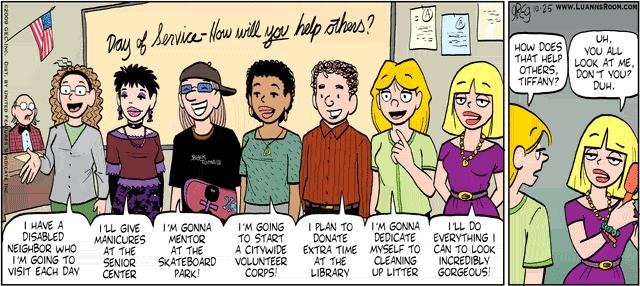
Halloween is a quintessential children’s holiday, and, since “Luann” appeals primarily to teenagers and young adults, its creator focuses most of an entire week’s worth of his comic strip on this festive occasion. The exception is the Sunday, October 25, 2009, edition. All of Evans’ Sunday strips are stand-alone works. They are not part of the daily sequence. Therefore, they must make sense by themselves. The strip for Sunday, October 25, 2009, shows Luann and her friends standing shoulder to shoulder at the front of their classroom. Behind them, the theme of the day’s lesson is written on the chalkboard: “Day of Service--How will you help others?” As their teacher, Mr. Fogarty, looks on, the students tell their peers what each of them intends to do during the Day of Service. Luann is the next to the last in line; Tiffany stands to her left. Each of the students except Tiffany plans to perform a more-or-less significant act of kindness and assistance. Bernice announces that she intends to “visit” a “disabled neighbor.” Crystal plans to “give manicures at the senior center.” Knute will “mentor at the skateboard park.” Delta hopes to “start a citywide volunteer corps.” Gunther intends to “donate extra time at the library.” Luann is going to “clean up litter.” Since all the other students have a relatively important and meaningful task in mind for the Day of Service, the reader anticipates that Tiffany, the last in line, will also have a noble and helpful task in mind. However, her announcement surprises both Luann and the reader. When Tiffany declares that she will do all that she “can to look incredibly gorgeous,” Luann turns to her, in the next panel, and asks, “How does that help others, Tiffany?” Although her explanation (“Uh. You all have to look at me, right? Duh.”) is obviously ludicrous, it reflects her shallow and narcissistic character, and, juxtaposed to her peers’ more important plans to help others, is amusing.


Octiber 26, 2009

The rest of the week focuses upon Halloween. In the October 26, 2009, strip, Frank and Nancy, seated across from one another in their living room, discuss what to hand out to visiting trick or treaters. Nancy confides to her husband, “I didn’t buy Halloween candy. I hate it that kids gorge on sweets, but I don’t know what to give. Carrots? Toys? Dimes?” Her practical husband suggests “garage stuff.” His response seems to surprise Nancy. “What?” she asks him. “We have junk in the garage we plan to sell,” Frank tells her. “Give it to the kids. Win-win.” Unimpressed, Nancy illustrates the absurdity of Frank’s suggestion. Pretending to give the garage items to visiting trick or treaters, she says, as if she were speaking to them, “A bent golf club for you, an ugly tie for you, a half roll of wallpaper for you, a broken lamp for you.” Her humorous protest prompts Frank to response, “See? It’s even kinda scary.” This strip uses a problem--children’s stuffing themselves with “sweets”--to set up a humorous attempt by the characters to find a solution. Nancy’s suggestions for alternative treats (“carrots. . . toys. . . dimes”) are serious, but Frank’s (“junk in the garage”) is both playfully self-serving and humorous. The strip combines a serious health issue with an everyday situation (cleaning out the family’s garage) and a holiday (Halloween) to appeal to a wide audience, which includes both children, adults, parents, and homeowners.

October 27, 2009

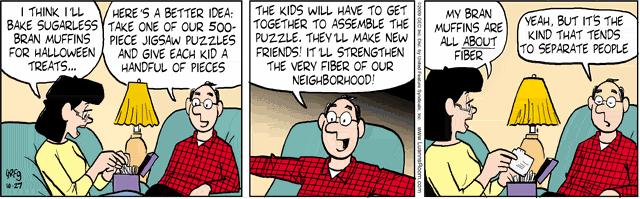
The October 27, 2009, edition of the comic strip continues the situation that the previous day’s installment established: what to give visiting trick or treaters on Halloween. Again, Frank and Nancy are seated opposite one another in their living room. Nancy opens the conversation between them: “I think I’ll bake sugarless bran muffins for Halloween treats.” Frank offers an interesting alternative. At first, it sounds ridiculous, even a bit cruel: “Here’s a better idea. Take one of our 500-piece jigsaw puzzles and give each kid a handful of pieces.” However, in the next panel, he explains his reasoning, and the idea doesn’t seem as absurd: “The kids will have to get together to assemble the puzzle. They’ll make new friends! It’ll strengthen the very fiber of our neighborhood!” Nancy’s response is based upon a play on the word “fiber” that Frank has used. “My bran muffins are all about fiber,” she observes. “Yeah,” Frank replies, “but it’s the kind that tends to separate people.” His response suggests that the fiber in the muffins will facilitate the children’s need to use the bathroom, since fiber has a laxative effect on people, and their doing so will cause them to “separate” rather than to “assemble.” This strip shows that both Nancy and Frank care about the welfare of children. Nancy has their health in mind, whereas Frank is concerned with their social wellbeing. Their proposed solutions to the problem of what treats to hand out to children on Halloween also show them to be creative. The conflict between them is gentle and rational, rather than harsh and emotional, showing that they are mature and logical adults. Like many of Evans’ other strips, this one, based upon a specific situation, reveals the traits of his characters’ personalities.


October 28, 2009

The October 28, 2009, edition of the comic strip continues the same situation, as Frank, discovering a kitchen “drawer full of rubber bands from the newspaper” to which they subscribe, suggests to Nancy, as she pours a cup of coffee, “Let’s give these out to the trick or treaters.” She asks a logical question in response, wondering what the recipients “are supposed to do with a rubber band.” In the next panel, Frank explains, “Honey, they’re kids. They’ll think of things.” Nancy agrees, but her rejoinder suggests that the “things” of which the children are apt to think to do with the rubber bands may be undesirable and, potentially, hazardous: “Yeah. Like zing you upside the head as you close the door.” Frank’s suggestion is based upon his understanding that children are imaginative, but Nancy’s comeback addresses another facet of adolescent behavior. Children, she suggests, are also unruly, and their rowdiness could cause unpleasant or dangerous results. It is evident that both characters, as the parents of Luann and Brad, understand children well. The strip also seems to imply that, in caring for children, two heads are better than one, because both Frank and Nancy contribute to an awareness of the nature of children which is truer and more developed than either of their perceptions would be by itself. Children are imaginative, as Frank points out, but they are also immature and disorderly at times, as Nancy indicates.


October 29, 2009

The October 29, 2009, edition of “Luann” is atypical in that it is not humorous in itself. Rather, it sets up the strip that is to appear the next day and, as the inclusion of a web address in the lower right corner of its single panel indicates, it is more of a public service effort than it is an attempt to tell a joke or to express humor. This time, the action, such as it is, occurs in Luann’s bedroom, as her dog, Puddles, sleeps on her bed and her best friend, Bernice, reading a magazine or a book, lounges on the floor, her back against the side of the mattress, while Luann contemplates a large collection of books in her bookcase. Bernice reads to Luann some facts that have captured her attention: “Wow. In America, kids collect almost 3 billion pieces of candy on Halloween.” She finds this information disturbing because of the hazards to children’s health that it represents: “That’s a lot of hyper, obese, bad-teeth kids.” Luann, contemplating her bookcase, says, “Look at all these old children’s books of mine. Wonder what I could do with them?” A teenager, she has outgrown the “children’s books.” What were once welcome diversions are now undesirable clutter to her. However, possibly because they have sentimental value to her, she doesn’t appear to want to simply discard them, for she wonders what she “could do with them.” The strip for the next day will provide the solution to her problem.


October 30, 2009

In the October 30, 2009 strip, Frank and Nancy are still trying to resolve their problem as to what to give trick or treaters in lieu of candy. This time, they are seated at the dining room table. Nancy names “apples” and “stickers” and other possibilities. Frank, once again, suggests an absurd alternative: “paper clips.” As her parents struggle with the issue, Nancy listing their ideas on a sheet of paper, Luann approaches them, carrying a tall stack of books. “How ‘bout givin’ my old children’s books?” she suggests. In the next panel, the parents are alone again, Luann having left the stack of books on the table. Her mother and father stare at the books, speechless. In the last panel, Nancy tosses her crumpled list as Frank offers the strip’s punch line: “It’s scary when she’s more clever than we are, isn’t it?” Although this strip, considered in isolation from the previous editions in the sequence, is not all that amusing in itself, its humor becomes funnier because it builds upon the continuing situation that previous days’ editions of the strip have developed, this one becoming, as it were, not only amusing in itself but the punch line for the whole series of related strips to date. Because Frank and Nancy have considered a series of possible alternatives to the giving of candy to visiting children as Halloween treats without success, Luann’s casual resolution of their long-running dilemma is also amusing, since she is a teenager, while they are adults. Usually, the parents solve problems, but, in this strip, the roles of parents and child are reversed, which helps to fuel the amusement.


October 31, 2009

The October 31, 2009, edition of the comic strip represents the culmination of the Halloween-based series as children visit the DeGroot household to trick or treat. Luann hands out the books. “Just for you,” she says to a girl in a witch’s costume, naming the title of the book she is giving her, “If I Ran the Zoo.” Her announcement of the book’s title brings her father running, as he cries out, in horror at the thought of the loss of the book, “That book is inscribed by Ted Geisel inside!” His announcement shocks Luann, who stares wide-eyed and speechless. “Ted Geisel” is the actual name of the author who has written a popular series of children’s books under the pen name “Dr. Seuss.” The fact that he has “inscribed” the book that Luann is giving away suggests that the volume may be worth a fair amount of money. As such, it is not something that is appropriate to be given away to a child, which explains Frank’s horror and the speed with which he intervenes, as well as Luann’s own shock. Luann’s diplomatic way of resolving this crisis is to offer the child two books for the one that she originally gives her, and the girl gladly accepts, so that, at the end, everyone--the girl, Luann, and Frank--is content with the outcome. Luann’s actions show her to be sensitive, kind, and tactful. She may be a teenager, but she is maturing well emotionally and morally, her behavior suggests. She is also witty, because her dialogue, constituting, as it does, a rhymed couplet, in her offering of two books for the one she originally gives the girl, resembles the rhyming couplets in which Dr. Seuss’ books are written.

Just as she earlier solved her parents’ dilemma concerning what to give trick or treaters instead of candy, Luann now resolves the crisis of reclaiming the book she originally gives a child in a diplomatic, and even witty, manner. Although her parents are obviously mature adults--Frank provides for the financial necessities of a family of four, just as Nancy keeps house for them, and both parents show an understanding of and a concern for both their own children and children in general--both Nancy and Frank can also act childishly on occasion, as is indicated by Frank’s panic at the possibility of losing a book signed by a famous author and his grabbing it out of Luann’s hands the moment she retrieves it from the trick or treater and Nancy’s earlier insistence that her bran muffins are superior to Frank’s suggestion for a Halloween treat because her muffins would be “all about fiber.” The comedy of “Luann” springs from Evans’ display of his characters’ personalities through their responses to the problems and conflicts which arise from specific situations related to everyday life. Such humor appeals to children, teenagers, parents, and other adults alike.

Works Cited

Evans, Greg. “Luann.” Comic Strip. The Las Vegas Review-Journal.
25 Oct. 2009-31 Oct. 2009: C8. Print.

Markstein, Don. (2009). Luann. Don Markstein’s Toonopedia. Retrieved November 4, 2009, from
http://www.toonopedia.com/luann.htm .
  

Sunday, July 17, 2011

Advertisement Analysis Essay 1

Copyright 2011 by Gary L. Pullman

According to Jib Fowles, to sell products and services, advertisers appeal to one or more of fifteen emotions:

1 The need for sex
2. The need for affiliation
3. The need to nurture
4. The need for guidance
5. The need to aggress
6. The need to achieve
7. The need to dominate
8. The need for prominence
9. The need for attention
10. The need for autonomy
11. The need to escape
12. The need to feel safe
13. The need for aesthetic sensations
14. The need to satisfy curiosity
15. Physiological needs: food, drink, sleep, etc.

In addition, I have found, most advertisements also use a visual metaphor, texts which often involve a play on words and suggests the visual metaphor, and, of course, various visual design elements (such as models, props, color, size, shape, and texture). In fact, in an assignment that I give my freshman composition students, I ask them to use the following sentence to structure their advertising analysis essay:

The name of product advertisement in Title of Magazine uses a metaphor to equate the product to an object or experience to which the advertised product is equated and uses such visual design elements as identify specific elements (colors, shapes, props) to sell the product.
To provide a model, I then offer this sample five-paragraph essay, first identifying the thesis sentence and the topic sentences, which I underline in the essay itself:

THESIS: To sell a men's magazine, the Ché advertisement in Commuter World magazine uses a metaphor to equate the product to a “better” dream world and shows a promiscuous young woman approaching a trolley station.

TOPIC SENTENCE 1: The advertisement’s text, “Let’s keep dreaming of a better world,” equates Ché magazine to a place in which beautiful, promiscuous young women are readily available to any man.

TOPIC SENTENCE 2: The female model is shown from behind, so that the viewer is encouraged to see her as an object rather than as a person.

TOPIC SENTENCE 3: The model approaches a trolley station, which symbolizes the connection that she intends to make with the train that will take her to her destination.
I also include a picture of the advertisement. Here’s the result:

INTRODUCTORY PARAGRAPH: Men’s magazines feature articles concerning topic of interest to their subscribers: alcoholic beverages, sporty automobiles, hunting and fishing, politics, scientific and technological breakthroughs, workplace guidance, travel and tourism, and, of course, dating. Some, such as Playboy, also boast of interviews with the rich and famous and of short stories by popular or even renown writers. There are apt to be jokes and cartoons, too, mostly about sexual matters. The mainstay of such magazines, however, isn’t the news, advice, humor, or fiction, but the photographs of beautiful young women wearing little or no clothing. It makes sense, then, that an advertisement for a men’s magazine, whether foreign or domestic, would appeal to such periodicals’ strongest selling point. If humor can be used to make the sales pitch, so much the better, but, when it comes to promoting men’s magazines, nothing sells as well as sex, as marketers for the European men‘s magazine Ché are well aware. To sell a men's magazine, the Ché advertisement in Commuter World magazine uses a metaphor to equate the product to a “better” dream world and shows a promiscuous young woman approaching a trolley station.

BODY PARAGRAPH 1: The Ché advertisement in Commuter World magazine uses a metaphor to equate the product to a “better” dream world. The accompanying text at the bottom of the advertisement, which is printed in smaller font than the message on the model’s skirt, indicates that the image that the advertisement creates--of a nubile young woman who is available to anyone who is interested in calling her--is a fantasy: “Let us keep on dreaming of a better world.” The advertisement has a playful tone, suggesting that the “better world” to which it alludes would be a fun place to be, and the fun would be of a physically intimate variety. Following this fine print, as it were, is the logo that identifies the product that the advertisement is selling, Ché, a “men’s magazine.” The model seems to represent the sort of fantasy girl that the magazine is apt to feature on a routine basis. By purchasing or subscribing to this magazine, customers gain admittance to the “better world” of fun-loving, available dream girls.

BODY PARAGRAPH 2: The female model is shown from behind, so that the viewer is encouraged to see her as an object rather than as a person. Her face is not shown. Therefore, the emphasis of the picture is on her body, rather than her face, on the physical rather than the personal. She is an object, rather than a person. She wears a simple, green top that exposes her midriff, a charm bracelet, and a white mini-skirt. A small, simple, black purse is slung over her right shoulder. She is the largest object in the picture, and she is the closest to the image’s center, her positioning within the picture, like her size, emphasizing her over everything else that is depicted in the advertisement. Next to the figure of the young woman herself, the most outstanding prop in the picture is her skirt. It is short enough to reveal the lower portions of her buttocks, which are bare, suggesting that she either wears a thong or no underwear at all. The exposure of these parts of her anatomy draws the eye, as does the apparent fringe that adorns the bottom of her skirt, some of the tassels of which are missing, revealing the parts of her buttocks that show. There is something else odd about the fringe: the tassels, which are short, rectangular strips, bear printed text that is too small to read. However, on the seat of her skirt, in red cursive lettering, below which is an arrowhead, pointing downward, is the message, “My number.” This message makes it clear to the advertisement’s viewer that the text printed on the tassels identifies her telephone number. Her skirt is itself an advertisement of the sort that includes, along its bottom edge, a series of tags that are printed with a telephone number to which those who are interested in the product or the service that the advertisement promotes may respond. Essentially, the model is saying, to all interested parties, “Call me.” It is based upon a play on words, alluding to the common phrase, “I have your number.”

BODY PARAGRAPH 3: The model approaches a trolley station, which symbolizes the connection that she intends to make with the train that will take her to her destination. The train represents opportunity. The model is approaching the station. If the viewer were present, he might meet her, and, if he were to join her on the trolley, the train might convey him--or, rather, him and the young woman--to a common destination. The silent text of the advertisement seems to be. “Don’t miss the train!” and represents a call to action, or, in the language of the trade, the closing sales pitch. From a Freudian point of view, the train is also a phallic symbol, which suggests, even more clearly, the sexual nature of the destination to which the young woman and her date will travel, if he calls her and arranges to meet her at the station.

CONCLUDING PARAGRAPH: If advertisements are any indicator of such matters, it seems safe to say that men and women are interested in vastly different types of pursuits. Advertisements in women’s magazines indicate that women are interested in spotless kitchens, a healthy, well-fed family, a clean home, fashionable clothing and accessories, travel, interior design, furniture, and business careers. Men’s magazines’ advertisements suggest that their readers’ interests are fewer by far and simpler: food, sex, and cars. An advertisement for Ché men’s magazine, in fact, makes it clear that many men would welcome as “a better world” one in which women are not only readily available sexually but travel to one’s doorstep, in answer to a telephone call. For most men, the advertisement suggests, life just doesn’t get any better than that!

Tuesday, May 13, 2008

Process Analysis Development Template

copyright 2008 by Gary L. Pullman


Note: We recommend that you read our "Essay Patterns of Development" post before you read this post.

Process Analysis: Explain the steps by which something occurs or by which a person accomplishes a particular process (a series of steps that results in a specific, predetermined outcome).

Note: If there are more than three steps, group them into three phases or stages. (In actuality, a process may involve many steps, but for the purpose of this essay, present only three steps, phases, or stages.)

Topic: Prepare to deliver a short speech in a public setting


Use this blank template to generate a thesis for your own process analysis essay:

THESIS:

Sunday, May 11, 2008

Cause-effect Development Template

copyright 2008 by Gary L. Pullman

Note: We recommend that you read our "Essay Patterns of Development" post before you read this post.

Cause-effect: Explain the cause or causes of an incident (effect). (When the incident, or effect, is a human being’s behavior, the cause is referred to as a motive.)

Note: Often, an essay will explain both the cause (or causes) and the effect (or effects) involved in two or more incidents, conditions, or circumstances.

Topic: Anxiety


THESIS: Anxiety concerning a task that must be performed may be caused by inexperience regarding the task, by imagining the worst outcome instead of the most likely one, and by a lack of planning and rehearsal.
Use this blank template to generate a thesis for your own cause-effects essay:


THESIS:

Analysis Development Template

copyright 2008 by Gary L. Pullman

Note: We recommend that you read our "Essay Patterns of Development" post before you read this post.

Analysis: Identify the parts that make up a whole and explain how each functions individually, how each is related to the other, and how they work together to serve a greater, common purpose (the function of the whole).

Topic: Story

Function of the Whole: A story recounts the actions of a character who struggles to attain a goal.


THESIS: The beginning of a story, which is known as the exposition, provides background information and sets the rest of story in motion; the middle, called the turning point, changes the protagonist’s fortune for better or worse; and the end, known as the resolution, determines the outcome of the conflict (the protagonist attains or fails to attain his or her goal).
Use this blank template to create your own thesis for an analytical essay:


THESIS:

Essay Patterns of Development

copyright 2008 by Gary L. Pullman


A generic table (Generic Table for Generating a Thesis Sentence) helps students to understand that the thesis sentence for a typical high school or freshman college essay contains a plan of development that breaks the essay’s topic into three related points; these points are the bases, in turn, of the topic sentences for the essay’s three body paragraphs.

However, more specific tables help students to customize this concept, adapting it to particular patterns of development.

Essays are composed according to a number of patterns of development:
  • Analysis
  • Argumentation
  • Causal analysis (cause-effect)
  • Classification (usually used with division)
  • Comparison (usually used with contrast)
  • Contrast (usually used with comparison)
  • Definition
  • Description
  • Division (usually used with classification)
  • Evaluation
  • Exemplification, or illustration
  • Narration
  • Persuasion
  • Process analysis (“how to”)
Note: Rhetoric and composition courses usually break these patterns of development into the following groups:
  • Definition
  • Description
  • Exposition
  • Causal analysis (cause-effect)
  • Classification-division
  • Comparison-contrast
  • Evaluation
  • Process analysis (“how to”)
  • Narration
  • Persuasion and argumentation
Charts, or tables, each consisting of one or more rows and several columns, provide a visual means of organizing material for essays that employ each of these patterns of development.

Each of these essay templates can be used to generate a thesis sentence that includes a plan of development containing three related points. The beginning of the thesis sentence will be the template’s topic (sometimes, slightly reworded), identified in the template’s left column, and the plan of development will be the three points listed in the template’s other three columns. For example, from the following template, this thesis sentence may be derived:


THESIS: Vampires and zombies are revenants who feed on human beings and are driven by simple motives.
Likewise, from the following table, this thesis may be developed:

THESIS: The legends concerning vampires and zombies differ, as do the religions with which they associated and the difficulty with which they are destroyed.

These tables are effective templates, but they have several limitations that the instructor must keep in mind. In some cases, their use implies an understanding of certain terms (e. g., metaphor, simile, personification, image, juxtaposition) that students may not have. In such cases, the instructor will need to define and exemplify the meanings of such terms before the students use the template. In other instances, as when a cause-effect, a comparison-contrast, or a classification-division essay (rather than simply a cause or an effect essay, a comparison or a contrast essay, or a classification or a division essay) is required, one template must be used with another, and some revision as to the employment of the templates may be in order.

For example, suppose a student were required to write a comparison-contrast essay. First, he or she should use the Comparison Essay template to identify the points of similarity between the two persons, places, or things that are to be compared. Then, he or she should use the Contrast Essay template to identify the points of difference between the two persons, places, or things that are to be contrasted. Then, the comparisons and contrasts should be linked in a single thesis sentence. Here is an example:

THESIS: Although vampires and zombies are both revenants who feed on human beings and are driven by simple motives, the legends concerning these monsters differ, as do the religions with which they associated and the difficulty with which they are destroyed.

Another note of caution is in order concerning the use of these tables. Most essays require a thesis that states not only facts but an interpretation of the facts (an opinion concerning them). These templates do not necessarily yield such a thesis. However, an opinion can be added, as is done in the case of the following thesis:

THESIS: Vampires are more complex villains than zombies because, although both monsters are revenants who feed on human beings and are driven by simple motives, the legends concerning vampires are more elaborate than those concerning zombies, as is the religion with which vampires are associated and the difficulty with which vampires are destroyed.

Generic Table for Generating a Thesis Sentence

This generic table helps students to understand that the thesis sentence for a typical high school or freshman college essay contains a plan of development that breaks the essay’s topic into three related points; these points are the bases, in turn, of the topic sentences for the essay’s three body paragraphs.

Once the student has understood this procedure and has practiced it several times using the generic table, he or she should be introduced, as the writing situation warrants each introduction, to the more specific tables that will help him or her to develop material (and theses) that relate to the specific pattern or patterns of development that are best suited to the writing assignment or the writer‘s purpose, whether this assignment or purpose is analysis, argumentation, causal analysis (cause-effect), classification (usually used with division), comparison (usually used with contrast), contrast (usually used with comparison), definition, description, division (usually used with classification), exemplification (illustration), persuasion, or process analysis (“how to”).

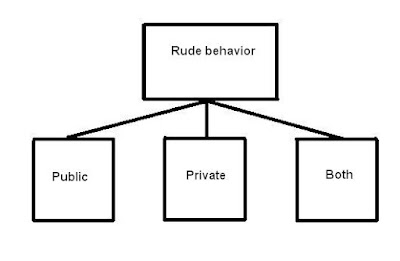
To use the generic table, replace “Essay’s Topic” (top rectangle) with the actual topic of the essay that is being written. Then, divide the topic into three related points, listing each point in its own square, in the order in which they will be presented in the essay. By reading down and to the right, in a counterclockwise direction, and adding an appropriate verb and linking words, as necessary, the student can easily develop a thesis sentence that includes a plan of development that contains three related points.

Here is an example:


By adding the verb “can occur,” the preposition “in,” the conjunction “or,” and the phrase “public and private areas of one’s life,” the student will have constructed a thesis sentence that includes a plan of development that contains three related points:

THESIS: Rude behavior can occur in public, in private, or in both public and private areas of one’s life.

Refer to the specific templates that appear in subsequent posts apply this generic technique to particular essay patterns of development written for the student.

Note: Each specific template (table) includes a completed table as a sample and a blank table that can be reproduced for the student’s use.