Fascinating lists!

Showing posts with label support. Show all posts

Thursday, September 22, 2011

Matching Game

Copyright 2011 by Gary Pullman

Your teacher has assigned you an essay in which you must make a claim that is based upon three related points. You start with your claim:

Mr. X is an ineffective instructor because __________________________________, __________________________________, and __________________________________.
Now, all you have to do is fill in the three blanks, giving reasons that support your claim. You think back over the course and come up with the following fillers for the blanks (the reasons that support your claim):

Mr. X is an ineffective instructor because he is impatient with students, he does not lecture on a level that is appropriate to his freshmen students, and he assigns class work and homework that do not relate to the course objectives.
That was easy, you think. This assignment should be done in no time at all!

You begin by brainstorming, and before you know it, you have drifted far from the first point in your thesis (Mr. X’s impatience with students). You let your hatred for the instructor lead you astray. Without being aware of doing so, you started thinking of how rude he is to students, how he tells lame jokes, and how he wastes class time telling personal stories about topics that do not have anything to do with the assignments or subject matter content on the syllabus. You also remember him being inconsiderate to a couple of students. As an example of an anecdote, he told a story about a fat man who tried one diet after another without success until he realized he had to change his hole lifestyle, get off the couch, and exercise as well as reduce his caloric intake--and there was a fat guy in class! Likewise, he made a point about avoiding sexist and racist language in essays--and there was a black chick in the class and half the students were women!

Before you know it, you have slipped away from your first point (Mr. X’ impatience with students) and started to write about his insensitivity, rudeness, and inconsideration toward students.

Let’s say you stayed on topic as you wrote about the second and third points in your thesis, Mr. X’s inappropriate level of communication during his lectures and his assignment of class work and homework that do not relate to the course objectives.

That means two thirds, or sixty-six percent, of your essay will actually remain on track, while a third of it will be sidetracked--if you don’t check the points in your thesis sentence against the points in your body paragraph’s topic sentences (and, equally importantly, the body paragraphs themselves).

Here’s a handy dandy way to do just this (before you hand in your paper) and save your grade.

Create a table that has three columns and four rows:


Label the top rows like this:
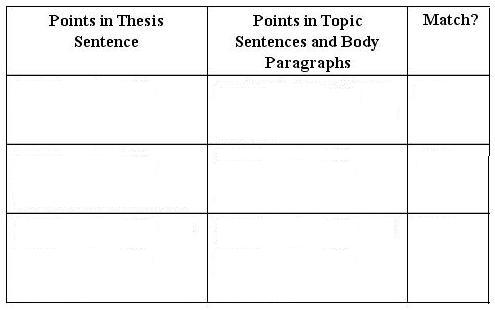

Now, as you check the points in your thesis against the points in your topic paragraphs (and the development of these points in the topic sentences’ respective body paragraphs), place “YES” in the “Match?” column if the points match or “NO” if they do not match.


Your matching game shows that the first point in your thesis sentence does NOT match the point in your first topic sentence or the way that the point in the topic sentence is developed in its body paragraph and that the second and third points in your thesis sentence DO match their counterparts in the second and third topic sentences and are developed correctly in these topic sentences’ respective body paragraphs. You have uncovered a very important error in your paper.

Fortunately, there is an easy way to correct the error and save your grade!

Simply change the second point in your thesis so that it matches the point that you actually make in your first topic sentence and support and develop in its body paragraph. Instead of turning in your paper with the original thesis sentence, turn in a revision with the corrected thesis sentence, which NOW reads:

Mr. X is an ineffective instructor because he is rude, inconsiderate, and insensitive toward his students; he does not lecture on a level that is appropriate to his freshmen students; and he assigns class work and homework that do not relate to the course objectives.
Notice we had to replace the commas between the items in the series with semicolons because the items in the first of the three phrases now contains commas, which the original phrase lacked: “he is rude, inconsiderate, and insensitive toward his students.”

Sunday, May 11, 2008

Essay Checklist

copyright 2008 by Gary L. Pullman

Use this checklist to make sure that you have written the most effective essay you can write. If you are able to answer "YES" (honestly) to each statement, you have done the best that you can do. Any statement t which you must answer "NO" shows you where you need to spend more time editing and revising your essay. Therefore, a "NO" response isn't bad. It's good, because it is helping you to see where you can improve your essay and, therefore, your grade.
  • In the upper left corner of my essay's first page, on line one, my name appears; on line two, my instructor's name appears; on line three, the course name appears; and on line four, the assignment's due date appears.
  • In the upper right corner of each page, my last name and the appropriate page number appears in a header.
  • My essay is typewritten in 12-point Times New Roman font.
  • My essay is left justified.
  • My essay is double spaced throughout (within and between paragraphs).
  • I have maintained one-inch margins at the top, bottom, and both sides of my essay.
  • My essay's title is centered at the top of the first page.
  • My essay's title focuses on the essay's topic.
  • My essay's title is interesting and captures the reader's attention.
  • My introductory paragraph uses an historical review, an anecdote, a surprising statement, a quotation from a famous person to capture my reader’s attention and make him or her want to read more of my essay.
  • My introductory paragraph does NOT apologize for my being a beginning writer, nor does it apologize for my not being an expert about my topic.
  • My introductory paragraph does NOT directly state my purpose, by writing something like “In this paper, I will. . . .” or “The purpose of this essay is to. . . .”
  • My essay does NOT start with a dictionary or an encyclopedia definition.
  • My introductory paragraph ends with my thesis sentence.
  • My thesis is NOT a statement of fact.
  • My thesis states an opinion that is open to discussion.
  • My thesis deals with a significant matter.
  • My thesis is specific, not general, and clear, not vague.
  • My thesis is made up of three related points.
  • Each body paragraph in my essay starts with a topic sentence.
  • The topic sentences refer to the points in my thesis, in the same order in which these points were made in the thesis.
  • I have used an adequate number of specific examples, comparisons, contrasts, quotations, statistics, explanations, and process analyses, as appropriate, to support and develop (provide evidence for) my topic sentences.
  • I have used appropriate transitions to show the nature of the relationships (cause-and-effect, chronological, comparison, contrast, exception to the rule, example, explanation, etc.) among my ideas.
  • My concluding paragraph restates my thesis (states it again, but in different words than I used to state it in the introductory paragraph).
  • My concluding paragraph issues a call to action, if appropriate, or provides another, effective closure for my essay.
  • My essay contains no misspellings.
  • My essay contains no usage errors (“to” or “two” instead of “too,” for example.)
  • My essay contains no punctuation errors (For example, I have made sure that commas and periods appear inside closing quotation marks but that semi-colons and colons appear outside closing quotation marks.)
  • My essay contains no fragments.
  • My essay contains no comma splices.
  • My essay contains no run-on sentences.
  • My essay contains no fused sentences.
  • My essay reflects the best writing of which I am capable.
Note: If your essay includes references to external sources, such as articles in newspapers, magazines, or journals; books; Internet articles; interviews; or other materials, you need to cite and document each and every such item. Refer to the Checklist for Research Papers post. For a sample essay that follows these guidelines (except for the indenting of paragraphs and double spacing, which cannot be replicated in this blog), refer to the "Sample Five-Paragraph Essay" post.

The Five-Paragraph Essay

copyright 2008 by Gary L. Pullman

Many high schools and colleges teach students to write a five-paragraph essay in which:
  1. an introductory paragraph (a) captures the reader's interest, (b) introduces the essay's topic, and (c) ends with a thesis sentence that contains a three-point plan of development;
  2. body paragraph 1 (a) starts with a topic sentence based upon the first point in the thesis and (b) uses specific details to support and develop the topic sentence;
  3. body paragraph 2 (a) starts with a topic sentence based upon the second point in the thesis and (b) uses specific details to support and develop the topic sentence;
  4. body paragraph 3 (a) starts with a topic sentence based upon the third point in the thesis and (b) uses specific details to support and develop the topic sentence;
  5. and ends with a concluding paragraph that (a) restates the thesis sentence in words other than those in which the thesis was stated originally (in the introductory paragraph) and (b) provides an appropriate closure to the essay.

Essays Made Easy uses this three-point thesis, five-paragraph essay format, because it helps to organize the writer's thoughts and provides a clear-cut, effective way of supporting and developing the writer's ideas.

In our next post, we will consider a sample essay that follows this format.